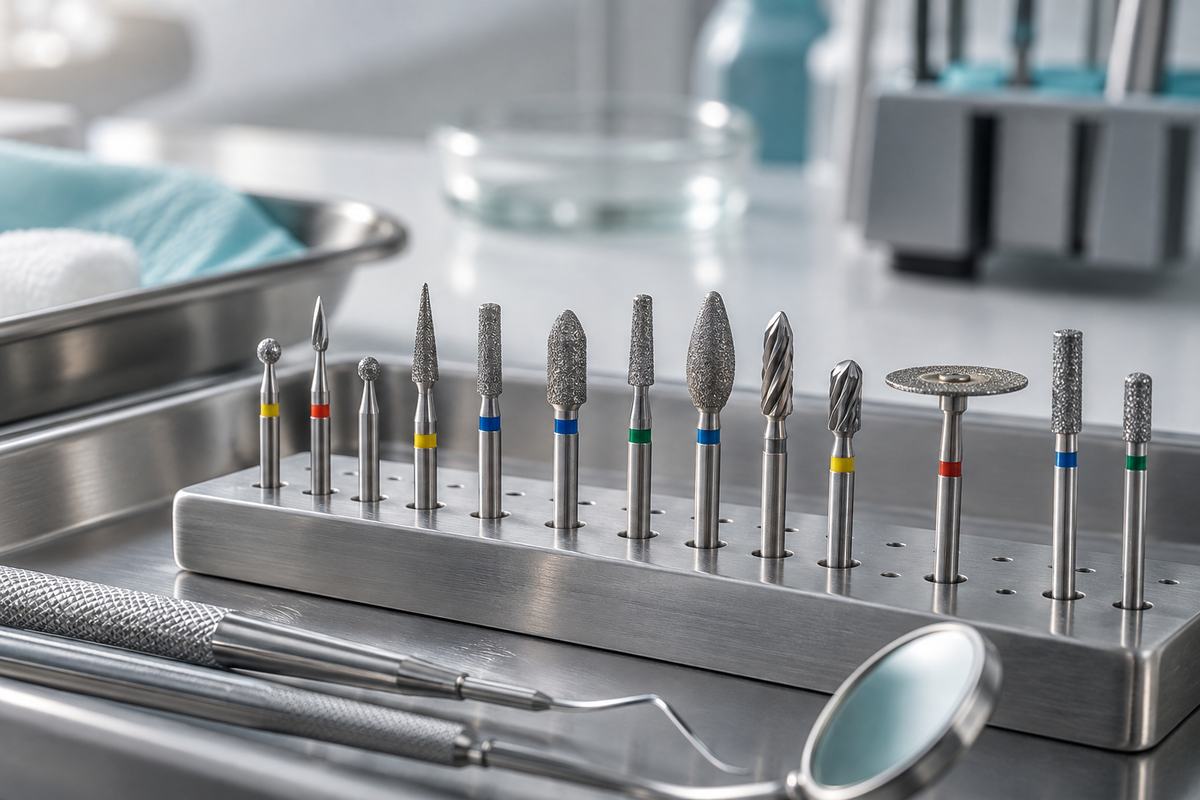
Wholesale buyers sourcing rotary cutting tools for dental clinics, laboratories, and distribution networks must evaluate product safety and regulatory compliance before placing volume orders. Importing uncertified dental rotary instruments creates legal risks for distributors, customs clearance delays, and safety hazards for dental practitioners. Procurement teams look for CE certified dental burs and verified ISO 13485 manufacturing facilities to confirm that products meet international medical device requirements.
Regulatory paperwork can appear confusing when factories provide multiple certificates from different issuing bodies. Understanding the distinct roles of CE marking and ISO 13485 certification helps purchasers evaluate factory claims, spot invalid documentation, and secure reliable supply chains for clinic networks and wholesale distribution.
The Difference Between CE Marking and ISO 13485 Certification
CE marking and ISO 13485 certification address two separate aspects of dental bur manufacturing. Many buyers mistakenly assume that an ISO certificate alone allows legal distribution in European and international markets, or that CE marking guarantees consistent day-to-day batch manufacturing quality. In reality, both standards work together to cover product safety and factory operations.
CE marking represents product conformity. It verifies that specific dental rotary instruments, such as diamond burs and carbide burs, meet health, safety, and performance requirements for medical devices. For dental burs, CE certification requires technical documentation that includes risk management files, clinical evaluation summaries, and mechanical safety tests covering head concentricity, bond strength, and corrosion resistance. The CE mark indicates that the physical product design is safe for clinical dental procedures.
ISO 13485 represents a quality management system standard specific to medical device manufacturing. An ISO 13485 certificate does not certify a single bur model. Instead, it audits the factory operating procedures across the entire production facility. This standard governs:
- Raw material inspection and supplier qualification for medical-grade stainless steel shanks and diamond grit.
- Production process controls, including CNC Swiss-lathe machining tolerances and electroplating bath parameters.
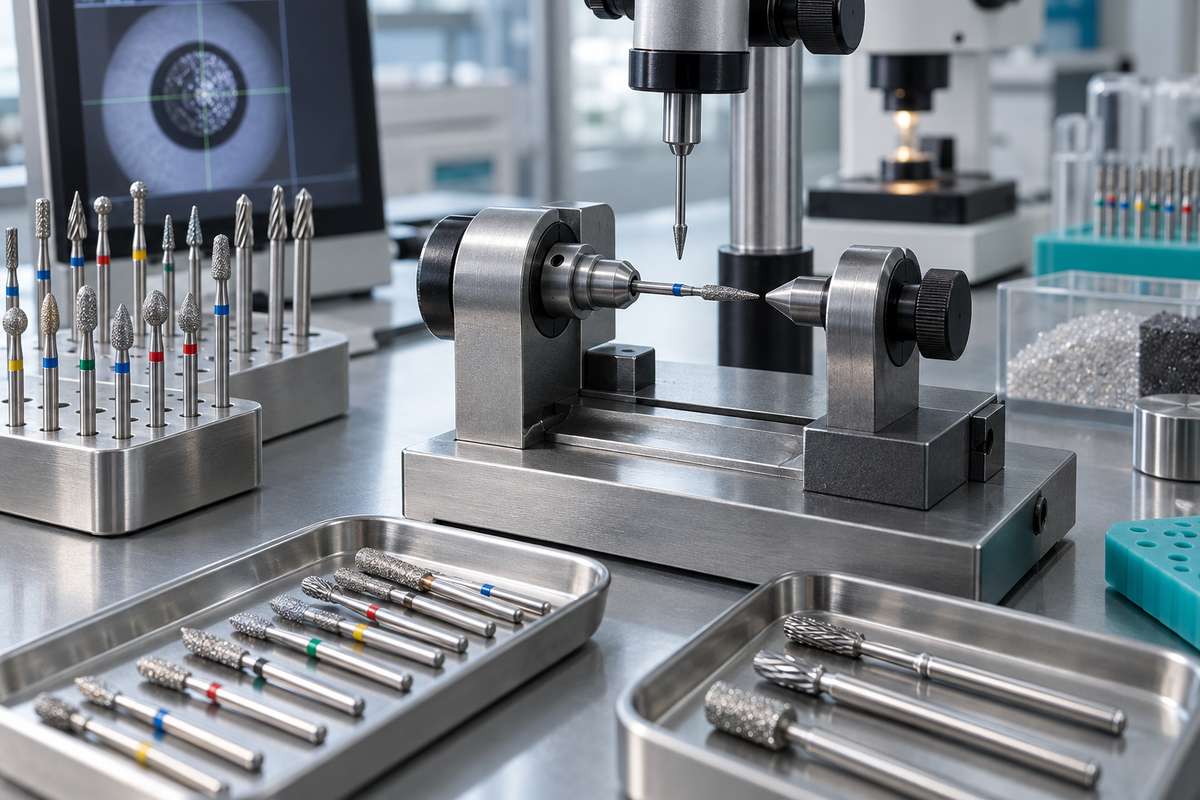
- Equipment calibration schedules for optical measurement systems and balance testers.
- Lot traceability and batch record retention from raw bar stock to finished clinic kits.
- Corrective and preventive action protocols when quality deviations occur.
While CE marking demonstrates that the product design complies with medical device standards, ISO 13485 ensures that the factory manufactures every batch to the same specifications year after year.
How to Verify Supplier Certificates and Avoid Counterfeits
The international market for dental supplies includes intermediaries who supply outdated, altered, or fabricated certificates. Wholesale purchasers and clinic network procurement officers should use a standard verification protocol before approving a new factory supplier.
First, identify the Notified Body or certification registrar named on the certificate. Legitimate CE certificates for medical devices are issued by accredited Notified Bodies, identified by a unique four-digit identification number printed alongside the CE logo. Genuine ISO 13485 certificates are issued by management system certification bodies accredited by international accreditation forums.
Second, check the exact scope of registration on the document. A valid certificate must explicitly cover dental rotary instruments, rotary cutting tools, or diamond and carbide burs. Dishonest vendors sometimes present an ISO 13485 certificate whose scope covers only non-medical dental accessories or manual laboratory tools, attempting to pass it off as coverage for high-speed surgical or operative burs.
Third, confirm company names and manufacturing site addresses. The company name on the certificate must match the invoicing entity, or the certificate must list the factory as the authorized manufacturing site. If the supplier is an export trading firm, request the manufacturing agreement linking the trading company to the underlying certified production plant.
Fourth, verify certificate validity directly on the issuing body public database. Most accredited registrars maintain online certificate checkers where buyers can enter the certificate registration number to verify active status, issue date, and expiration date. If an online database is unavailable, email the registrar verification desk directly with a PDF copy of the certificate.
Quality Control Standards in Dental Bur Manufacturing
Physical quality control on the factory floor determines how certified designs perform in dental handpieces. Operating under an ISO 13485 quality system requires structured inspection stations at every stage of the manufacturing workflow.
Bur concentricity testing is the most critical physical check. High-speed dental handpieces operate at speeds up to 400,000 RPM. If a bur head deviates from the centerline of the shank by more than a few microns, the resulting runout creates violent vibration, accelerates handpiece turbine wear, and causes patient discomfort during enamel reduction. Certified factories inspect shank runout using laser micrometer gauges before diamond plating or carbide head welding.
Shank dimensional tolerance verification ensures proper chuck engagement. Friction grip (FG) shanks must maintain a precise diameter of 1.60 mm within tight ISO tolerances. If a shank is undersized, the bur slips inside the handpiece chuck under cutting load. If oversized, the bur jams in the turbine. Standard quality checks verify shank hardness, surface roughness, and overall length.
For diamond rotary instruments, abrasive particle bonding determines cutting longevity. Automated electroplating tanks deposit nickel matrix layers that lock diamond crystals at consistent exposure depths. Batch sampling tests evaluate diamond retention under heavy shear forces to prevent premature particle stripping during crown preparations.
BurDental was founded in 2008 and operates as an ISO 13485 factory manufacturing CE marked rotary instruments. Production lots undergo optical coordinate measurement, hardness testing, and runout inspection before packaging into autoclavable bur block holders or bulk blister packs.
Comparing Regulatory and Quality Frameworks for Dental Burs
Dental bur distributors and private label brand owners operate across multiple geographic markets. Understanding how CE marking, ISO 13485, and FDA registration compare helps regulatory managers prepare appropriate compliance documentation for customs import and local sales.
| Standard or Framework | Scope and Target | Primary Focus | Verification Method | Documentation Required |
|---|---|---|---|---|
| CE Marking | Product-specific certification | Clinical safety and performance compliance | Technical file review by accredited Notified Body | Declaration of Conformity and CE Certificate |
| ISO 13485 | Factory-wide management system | Quality control consistency and batch traceability | On-site factory audit by accredited registrar | ISO 13485 Management System Certificate |
| FDA Registration | Facility listing and device classification | Market notification for distribution in the United States | Manufacturer establishment registration and listing | FDA Establishment Identifier and Device Listing Number |
While CE marking and ISO 13485 focus on third-party audits of technical files and quality processes, FDA registration for Class I rotary instruments primarily involves establishment registration and device listing. Experienced distributors maintain complete technical files combining all three frameworks to service international dental accounts.
Ordering Compliant Rotary Instruments for Clinics and Dealers
Wholesale buyers purchasing dental burs in bulk should request a complete regulatory packet alongside commercial price quotations. Factory-direct suppliers provide these documents to facilitate customs clearance and hospital tender submissions.
When ordering standard stock items, such as round diamond burs (SKU 001-008S, SKU 001-010M, and SKU 001-012M) or precision CAD/CAM milling burs (SKU VH-00-06-ED, SKU VH-00-10-ED, and SKU VH-00-25-ED), request batch-specific Certificates of Analysis (COA) and Certificates of Conformance (COC). These documents confirm that the delivered lot matches the technical specifications defined in the factory quality file.
For distributors developing private label lines or custom clinic kits (such as SKU 4103, SKU 4104, and SKU 4105), factory compliance documentation supports distributor brand packaging. Factory-direct OEM programs allow dealers to customize bur packaging, blister foil printing, and bur block configurations while maintaining complete manufacturing traceability back to the ISO 13485 production line.
Procurement teams can request product samples and compliance files to test cutting efficiency and handpiece fit before placing volume production orders. Contact BurDental via WhatsApp at +86 186 8057 1046 to request factory documentation, product samples, and a detailed shipping quote for your destination port.
Frequently asked questions
How do I check if a supplier has genuine CE certified dental burs?
Request a clear copy of the CE certificate and verify the four-digit Notified Body number on the official European accreditation database. Confirm that the scope explicitly lists dental rotary instruments and that the certificate expiration date is valid.
What is the difference between ISO 13485 and ISO 9001 for dental bur factories?
ISO 9001 is a general industrial quality standard, while ISO 13485 includes specific medical device requirements for risk management, cleanroom packaging, lot traceability, and bio-burden control. Dental rotary instruments must be manufactured under medical device standards to ensure patient safety and regulatory compliance.
Does BurDental provide certificates of analysis with bulk orders?
Yes, BurDental provides batch-specific Certificates of Conformance and inspection records confirming shank diameter tolerances, concentricity, and diamond plating quality with commercial shipments. Contact our export sales team to include required compliance documentation with your order.
Can OEM and private label orders use our distributor brand under factory CE certification?
Private label distributors can market factory-produced rotary instruments under OEM agreements supported by factory technical files. The packaging must reference the legal manufacturer and quality traceability codes according to applicable medical device labeling standards.