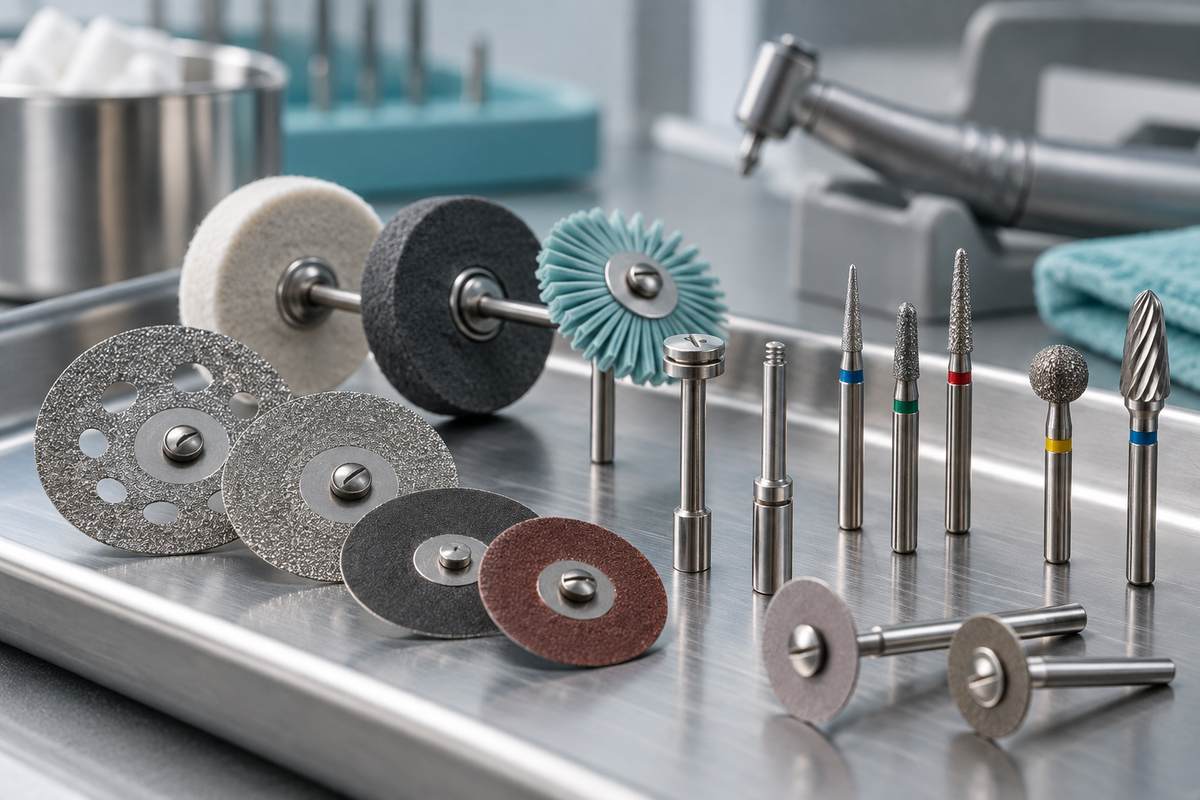
Dental rotary tools depend on reliable mounting hardware to transfer motor drive into cutting, trimming, and finishing actions. While standard rotary burs receive primary attention in purchasing catalogs, dental mandrels, cutting discs, and polishing wheels perform substantial processing work across dental laboratories and clinical operatories. Separating bridge sprues, trimming gypsum models, refining interproximal ceramic margins, and polishing acrylic denture bases all require rotary discs or abrasive wheels securely mounted on dedicated shafts.
Wholesale purchasers, dental distributors, and laboratory managers must evaluate rotary accessories as complete operating systems. A cutting disc or polishing wheel cannot function without a true-running mounting shaft designed for its exact core geometry. Selecting the right retention mechanism, matching shank types to dental handpieces, and stocking dependable consumable replacements reduces tool breakage, protects handpiece chucks, and keeps production lines efficient. BurDental manufactures rotary instruments, laboratory mandrels, and finishing accessories factory-direct for clinics and dental supply dealers.
Mechanical retention types for dental mandrels
Dental mandrels serve as intermediate arbors that connect unmounted abrasive media to dental handpieces. The retention mechanism at the mandrel head determines which abrasive discs, polishing wheels, or sandpaper bands the shaft can hold. Choosing the wrong mounting design causes disc slippage under load, eccentric rotation, or structural failure of brittle cutting materials.
Three primary retention designs dominate dental clinical and laboratory setups:
- Screw-top mandrels: These mandrels feature a threaded hole at the working end and a matching miniature retention screw. The technician threads the screw through the center arbor hole of an unmounted wheel or disc, tightening it flush against the mandrel collar. Screw-type mandrels provide rigid mechanical clamping, making them the standard choice for mounting rigid diamond discs and unmounted grinding stones during heavy separating and trimming tasks.
- Split-shank mandrels: Also known as slotted mandrels, these tools have a longitudinal slit along the working head. Technicians insert the end of an abrasive strip or mounted sandpaper band (such as SP-240, SP-400, or SP-600 grit rolls) into the slot and wrap the abrasive around the mandrel body. As the handpiece rotates, centrifugal force and rotational friction hold the abrasive wrap firmly in place for smoothing acrylic custom trays and denture borders.
- Snap-on and pop-on mandrels: Designed for rapid chairside workflows, these mandrels utilize a miniature square, cross, or rounded metal lug that snaps directly into the flexible hub of finishing discs. Clinicians change disc grits across coarse, medium, and fine stages without using screwdrivers, speeding up direct composite polishing.
Regardless of the head mechanism, high-quality mandrels are precision-machined from stainless steel to resist rust during ultrasonic cleaning and maintain concentricity under high torque.
Matching mandrel shanks to dental handpieces
A mandrel must fit the chucking mechanism and operational speed profile of the intended handpiece. Using an improper shank geometry causes poor grip, chuck wear, excessive runout, or dangerous tool detachment.
Dental facilities manage three distinct shank standards across clinical and laboratory departments:
- HP straight shanks: Handpiece (HP) shanks feature a long, smooth cylindrical shaft without locking notches. HP shanks are the universal standard for dental laboratory bench micromotors, straight handpieces, and heavy-duty lab engines. The extended length allows technicians to reach deep inside plaster model arches and framework contours while maintaining steady hand support.
- RA latch-type shanks: Right Angle (RA) shanks feature a mechanical retention groove and flat notch at the terminal end. RA shanks lock positively into the latch head of low-speed contra-angles used primarily at chairside for intraoral polishing and finishing. The mechanical latch prevents axial displacement during low-speed rotary manipulation.
- FG friction grip shanks: Friction Grip (FG) shanks are smooth, compact shafts held entirely by the internal collet chuck of high-speed clinical handpieces. While specialty micro-mandrels exist in FG configuration for rapid chairside composite work, heavy cutting and polishing discs are generally restricted to HP and RA handpieces to avoid exceeding safe rotational limits.
Technicians must verify that the handpiece chuck is clean and debris-free before inserting any mandrel. Grit accumulation inside collet chucks prevents mandrels from seating concentric, generating vibration that damages handpiece bearings and shatters abrasive discs.
Diamond discs and trimming discs for lab and clinic workflows
Cutting discs and trimming wheels are essential consumables paired with laboratory mandrels. Selecting the right disc geometry and grit distribution ensures clean separations without chipping delicate restorative margins.
Laboratory technicians and clinical prosthodontists rely on two specialized disc categories:
- Separating and plaster diamond discs: Heavy-duty diamond discs (such as N22D20, N19D20, and C40D30) are engineered for bulk cutting tasks. Technicians use these discs on HP screw mandrels to section multi-unit bridge sprues, separate stone dies from master models, and cut hard dental alloys. Discs with diamond coating on both faces and along the periphery allow rapid plunge cuts with minimal binding.
- Precision trimming discs: Fine diamond trimming discs (including models such as R12, C10, and S10) feature ultra-thin metal cores coated with fine diamond particles. These flexible or semi-rigid discs allow technicians and dentists to contour interproximal contact zones, shape ceramic embrasures, and refine margins on zirconia and porcelain crowns without removing excess adjacent material.
Using perforated diamond discs improves visual control during delicate cuts and aids in dissipating heat. Because dental ceramics are sensitive to thermal shock, applying light, intermittent pressure while running true-mounted diamond discs prevents micro-fracturing along restorative margins.
Lathe polish brushes and bench finishing wheels
While handheld mandrels provide precision control for localized grinding, high-volume surface finishing of full dentures and dental appliances takes place on stationary dental polishing lathes.
Dental bench lathes operate with tapered threaded spindles that accept central arbor wheels rather than slender mandrels. Production laboratories organize bench finishing across distinct wheel formats:
- Bristle lathe brushes: Multi-row lathe polish brushes feature dense rows of natural or synthetic bristles mounted around a solid plastic or wooden center hub. When loaded with coarse pumice slurries, these brushes access interdental papillae and gingival contours on acrylic denture bases, smoothing surface irregularities without flattening anatomical anatomy.
- Wire lathe wheels: Brass or steel wire brushes mounted on lathe spindles are used for heavy cleaning and oxide removal on cast metal frameworks and investment materials prior to sandblasting.
- Interleaved felt and cloth wheels: Soft muslin, flannel, and felt wheels provide the final high-gloss buffing stage when paired with fine polishing paste. Technicians use light pressure against the spinning lathe wheel to bring prosthetic acrylics and cast alloys to an unblemished, plaque-resistant mirror finish.
Wholesale purchasers should stock lathe brushes with reinforced center hubs to ensure true rotation on tapered lathe spindles, preventing wobble that creates uneven wear patterns across brush bristles.
Rotary accessories selection and compatibility guide
The following table summarizes common rotary accessories, compatible drive systems, and their primary applications across dental laboratories and clinics.
| Rotary accessory category | Representative SKUs and formats | Compatible drive and shank | Primary clinical and lab application |
|---|---|---|---|
| Laboratory mandrels | Screw-top HP, Split-shank HP | Straight HP bench micromotor | Mounting unmounted discs, stones, and sandpaper |
| Heavy diamond discs | N22D20, N19D20, C40D30 | HP screw mandrel on lab motor | Model die separation, plaster trimming, sprue cutting |
| Precision trimming discs | R12, C10, S10 | HP screw mandrel, RA latch mandrel | Interdental ceramic contouring, embrasure refinement |
| Abrasive sandpaper rolls | SP-240, SP-400, SP-600 | HP split-shank mandrel | Rapid acrylic tray smoothing, baseplate adjustment |
| Lathe polishing brushes | Multi-row bristle wheels | Tapered bench lathe spindle | High-volume pumice polishing of acrylic dentures |
Bulk purchasing and factory-direct sourcing considerations
Managing dental rotary accessories across multi-operatory practices or commercial dental laboratories requires balancing tool precision with unit procurement costs. Ordering mandrels and replacement consumables directly from a certified manufacturing source provides several operational advantages:
- Concentricity and dynamic balance: Low-cost stamped mandrels often exhibit shaft runout that causes handpiece vibration and uneven disc wear. Sourcing factory-tested, precision-turned stainless steel mandrels protects expensive handpiece chucks and ensures smooth, chatter-free cutting.
- Material grade and sterilization resistance: Laboratory and clinical mandrels undergo harsh disinfection routines, ultrasonic cleaning baths, and repeated steam autoclaving. High-grade stainless steel shanks resist surface pitting, corrosion, and thread degradation over extended reprocessing cycles.
- Consumable replenishment ratios: Because cutting discs, trimming wheels, and sandpaper bands wear out much faster than steel mounting shafts, purchasing managers should establish balanced replenishment ratios. Ordering bulk packs of consumable discs alongside standard mandrel sets avoids inventory stockouts and reduces shipping overhead.
- OEM and private label packaging: Dental supply dealers and large laboratory networks can access private label programs, including custom shank laser marking, customized blister cards, and tailored clinic starter assortments.
BurDental has manufactured precision dental burs and rotary accessories since 2008 in an ISO 13485 certified facility with CE marked production standards. For wholesale orders, custom kit configurations, or shipping quote requests, contact our sales department through WhatsApp at +86 186 8057 1046.
Frequently asked questions
How do you choose between screw-type and snap-on dental mandrels?
Screw-type mandrels provide rigid mechanical clamping for stiff diamond discs and grinding wheels during heavy lab separating and trimming. Snap-on mandrels allow fast interchanging of flexible abrasive discs during multi-step clinical composite contouring and polishing.
What handpiece shanks are available for dental mandrels?
Mandrels are primarily produced with straight HP shanks for dental laboratory bench micromotors and RA latch shanks for low-speed clinical handpieces. Specialty compact configurations are also available for specific clinical handpiece chucks.
How often should dental mandrels be inspected and replaced?
Mandrels should be inspected during every reprocessing cycle for bent shafts, stripped retention threads, and collet scoring. Any mandrel exhibiting visible runout or thread damage must be discarded immediately to prevent disc failure and handpiece damage.
Can diamond discs and mandrels be sterilized in a dental autoclave?
Stainless steel mandrels and electroplated diamond discs can be cleaned in ultrasonic baths and sterilized in standard steam autoclaves. Technicians must dry mandrels thoroughly after washing to prevent moisture entrapment in threaded screw sockets before autoclaving.