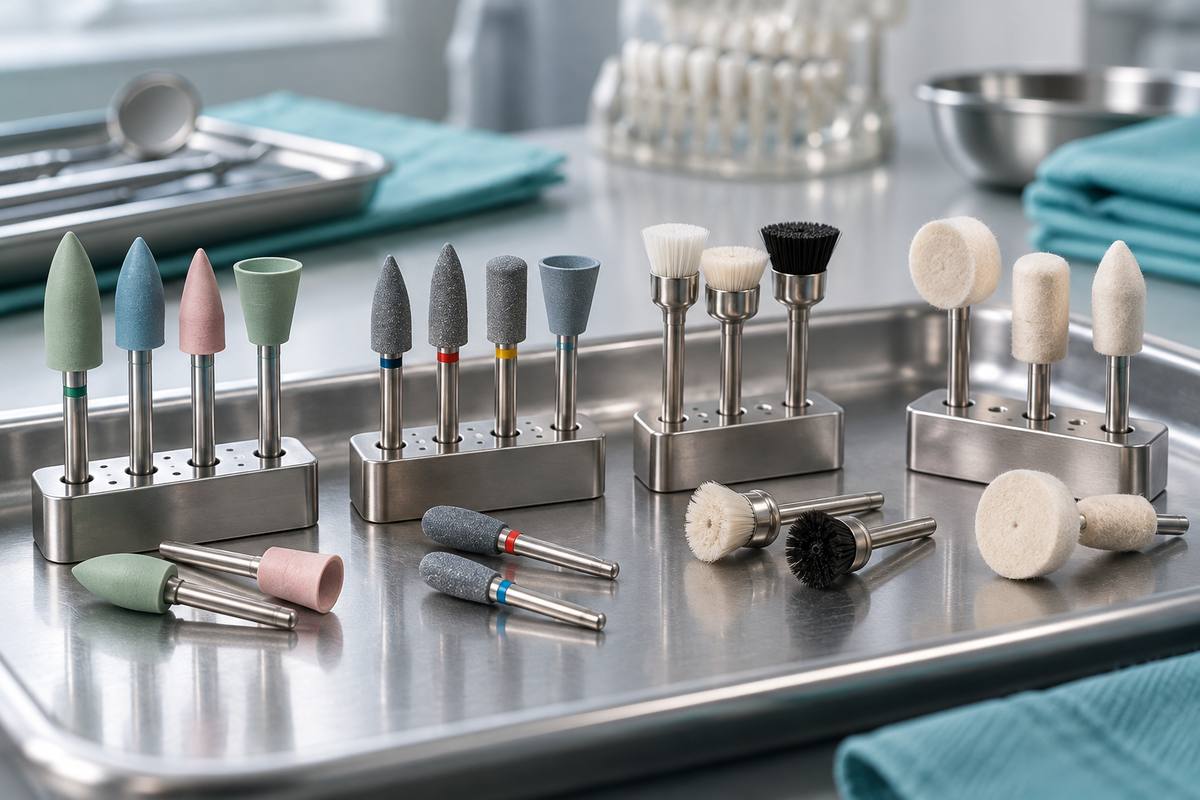
Dental polishing burs represent the final mechanical stage in direct restorations, prosthetic adjustments, and laboratory finishing workflows. While carbide and diamond burs cut tooth structure and shape restorative materials, polishing instruments refine surface textures to eliminate micro-grooves, reduce plaque retention, and produce a natural surface luster. Choosing the correct polishing rotary tool determines both the aesthetic outcome and the physical longevity of crowns, bridges, composite fillings, and removable appliances.
Dental practitioners and lab technicians work with diverse substrates ranging from soft acrylic resins and hybrid composites to dense monolithic zirconia and cobalt-chrome alloys. No single polishing bur works across all these materials. Achieving a mirror finish requires matching the abrasive grain, binder matrix, and rotary carrier to the specific material hardness and anatomical geometry.
Core categories of dental polishing burs
Professional dental polishing systems fall into four distinct product groups based on their construction, elasticity, and abrasive carrier mechanism.
Silicone polishing burs
Silicone polishers incorporate abrasive particles such as silicon carbide or aluminum oxide uniformly dispersed within a flexible synthetic silicone matrix. As the polisher rotates against the restoration, the silicone binder yields slightly under pressure, allowing the abrasive particles to level surface irregularities without gouging margins or flattening secondary anatomical anatomy. These tools are standard for shaping and smoothing direct restorations using silicon polishing burs for composites. They are available in cups for convex cusps, flame points for occlusal fissures, and discs for interproximal areas.
Diamond rubber polishers
For ultra-hard substrates like CAD/CAM ceramics and sintered zirconia, standard silicon carbide abrasives lack sufficient hardness to polish efficiently. Diamond rubber polishers utilize industrial diamond particles embedded in dense synthetic rubber matrixes. Instruments such as diamond rubber polishers (including models like SR101M, SR103M, and SR105M) remove micro-scratches from adjusted ceramic surfaces without generating excessive heat that could trigger phase transformations in zirconia.
Miniature polishing brushes
Polishing brushes use mounted natural bristles, synthetic filaments, or fine metal wires secured into steel mandrels. Clinicians and lab technicians select miniature polishing brushes with goat hair or Chungking bristles to carry polishing paste into deep occlusal grooves, developmental pits, and interproximal embrasures where solid rubber wheels cannot reach. Wire brushes provide preliminary cleaning and scale removal on cast metal frameworks.
Felt bobs and wheels
Felt instruments consist of compressed wool fibers shaped into cones, cylinders, or wheels. Used primarily with diamond polishing paste or aluminum oxide compounds, felt bobs and burs generate the final high-luster buff on metals, acrylic denture bases, and veneered porcelain. The porous wool fiber structure holds polishing paste against the rotating contact zone, maximizing optical reflectivity.
Substrate compatibility and bur selection
Selecting the right bur geometry and material matrix prevents surface damage and excessive chairside or bench time.
- Direct composite resins: Begin with medium-grit silicone polishers to remove scratches left by fine finishing diamonds. Follow with fine silicone points to establish a satin finish, and complete with ultra-fine silicone polishers or miniature bristle brushes with polishing paste for enamel-like gloss.
- Zirconia and lithium disilicate: Diamond rubber polishers are required. Standard stones or silicone polishers wear away rapidly against sintered ceramics without refining the surface. Multi-step diamond rubber systems smooth ground margins and restore surface glaze after occlusal adjustment.
- Cobalt-chrome and non-precious alloys: Initial prep utilizes mounted stones or carbide cutters, followed by hard rubber wheels, miniature wire or stiff bristle brushes, and final buffing with high-density felt bobs loaded with metal polishing paste.
- Denture base acrylics: Flexible rubber polishers smooth trimmed borders, followed by soft bristle wheels and felt cones using pumice and polishing compound.
Polishing bur comparison by abrasive type
The table below summarizes the operational characteristics of the primary dental polishing bur groups:
| Polishing bur category | Abrasive composition | Target dental material | Available shank types | Application stage |
|---|---|---|---|---|
| Silicone polishers | Silicon carbide / Aluminum oxide | Direct composites, compomers | RA, FG, HP | Pre-polishing to high-gloss |
| Diamond rubber polishers | Diamond particles in rubber matrix | Zirconia, lithium disilicate, porcelain | RA, HP | Medium smoothing to high shine |
| Miniature polishing brushes | Natural bristle, nylon, wire | Occlusal anatomy, cast metals | RA, HP | Paste carrier and contour buffing |
| Felt bobs and wheels | Compressed wool fibers (with paste) | Cobalt-chrome, acrylics, ceramics | HP, Mandrel | Final mirror finish buffing |
Clinical and laboratory speed guidelines
Rotary polishing instruments operate at lower rotational speeds than cutting burs. Operating polishing burs at excessive speeds causes thermal buildup, degrades the flexible binder matrix, and can cause irreversible pulpal trauma or micro-cracks in ceramic margins.
- Intraoral silicone and diamond rubber polishers: Operate slow-speed handpieces with light, intermittent contact and adequate air or water coolant. Constant heavy pressure generates localized frictional heat and accelerates bur head deformation.
- Laboratory handpiece tools: HP shank polishers and felt wheels running on dental lab micro-motors require sweeping, uniform motions across crowns or acrylic bases to avoid uneven flat spots.
- Hygiene and infection control: Clinical silicone and diamond rubber polishers are autoclavable and withstand standard steam sterilization cycles. Laboratory brushes and unmounted felt bobs are maintained through dry storage or batch replacement protocols.
Factory-direct wholesale supply from BurDental
BurDental operates an ISO 13485 certified dental manufacturing facility founded in 2008, producing precision rotary instruments with CE marked compliance. We supply dental distributors, group purchasing organizations, hospital systems, and commercial laboratories with factory-direct polishing burs, clinic kits, and laboratory rotary tools.
Our manufacturing capabilities include OEM private labeling, custom grit formulation, specialized shank configurations (FG, RA, and HP), and clinic-ready packaging. Buyers benefit from low minimum order quantities and direct manufacturer pricing. For wholesale catalogs, sample collections, or custom manufacturing inquiries, contact our export team via WhatsApp at +86 186 8057 1046.
Frequently asked questions
What is the difference between finishing burs and polishing burs?
Finishing burs, including multi-fluted carbide burs and fine-grit diamond burs, cut and contour hard materials to establish margins and anatomy. Polishing burs use flexible rubber matrices, silicone binders, bristles, or felt carriers to smooth microscopic surface roughness and create gloss without removing bulk material.
Can silicone polishing burs be sterilized in an autoclave?
Clinical silicone polishing burs with stainless steel RA or FG shanks are heat-resistant and can be sterilized in standard dental autoclaves. Technicians and assistants should rinse away debris before autoclaving to maintain abrasive bonding integrity.
Why are diamond rubber polishers recommended for zirconia restorations?
Sintered zirconia is too hard for conventional aluminum oxide or silicon carbide polishers. Diamond rubber polishers use industrial diamond grit to smooth hard ceramic surfaces efficiently while the rubber matrix cushions contact, preventing localized thermal stress and surface micro-fractures.
How do clinics and dental laboratories order polishing burs in bulk?
BurDental provides factory-direct wholesale purchasing with low minimums, private label packaging, and global dispatch from our ISO 13485 facility founded in 2008. Inquiries and bulk orders can be arranged directly with our team via WhatsApp at +86 186 8057 1046.