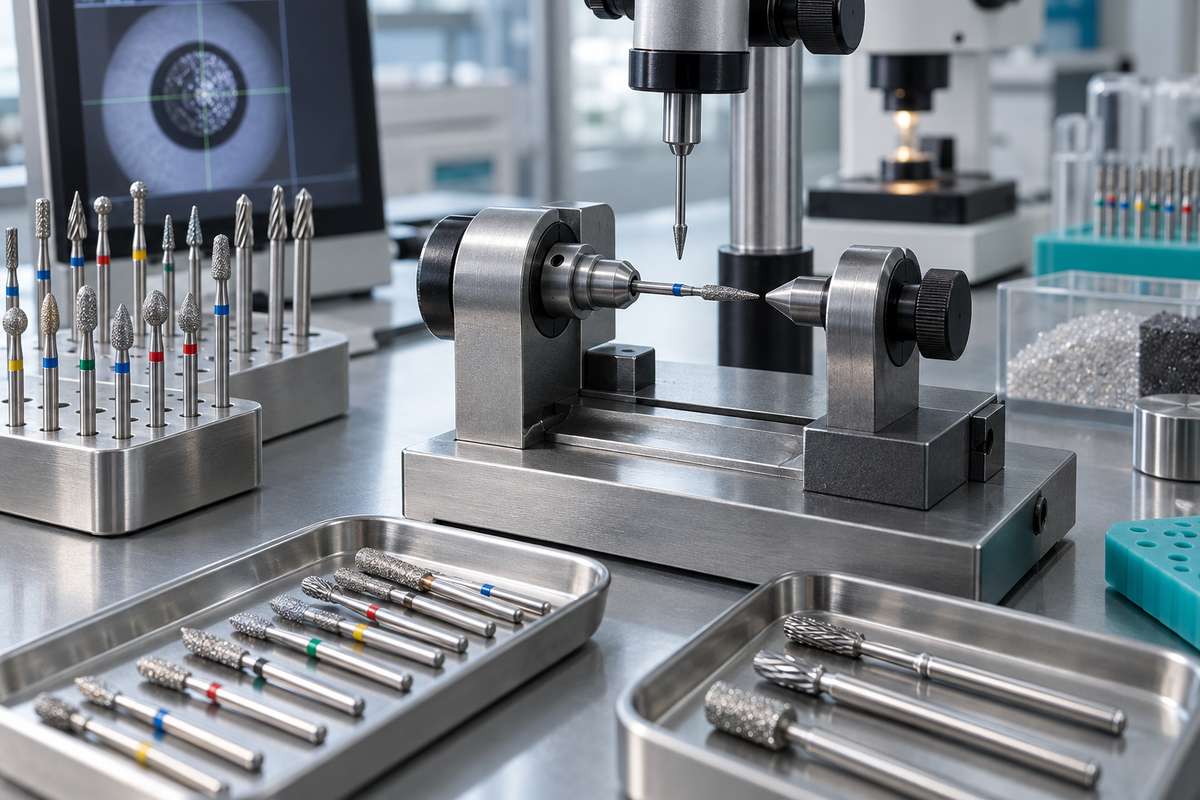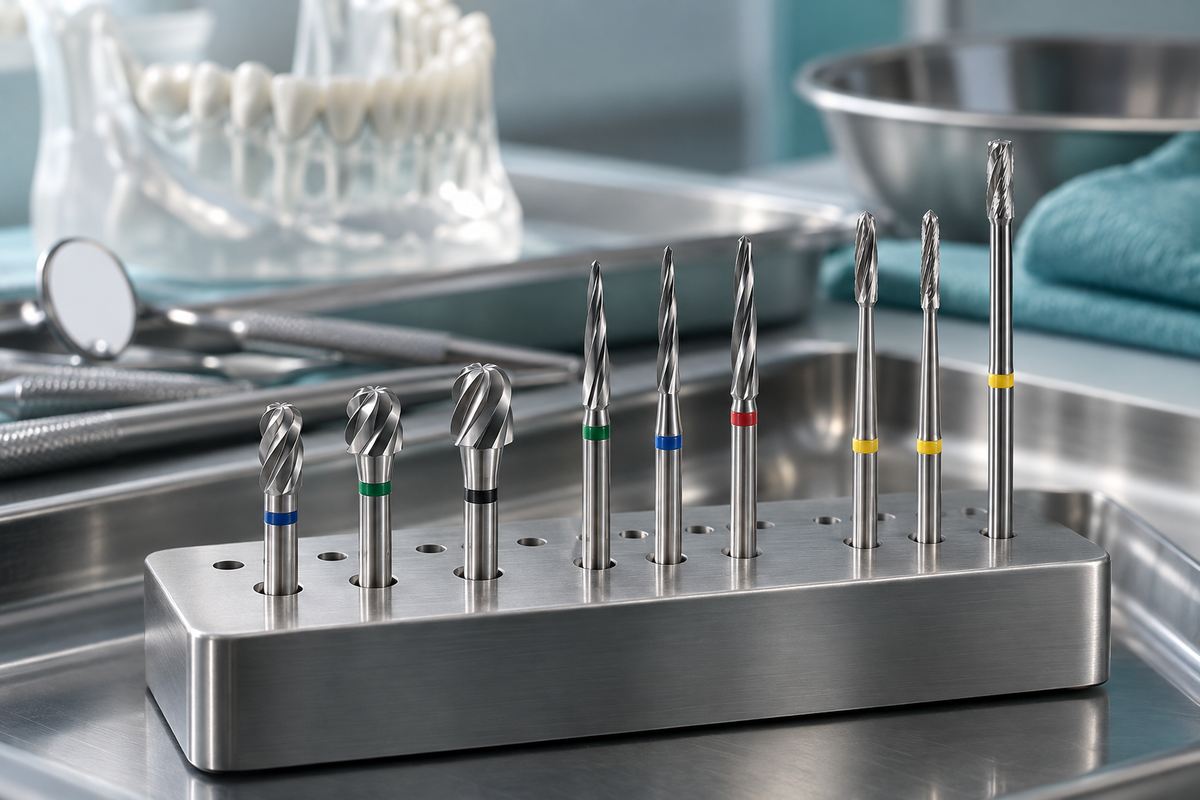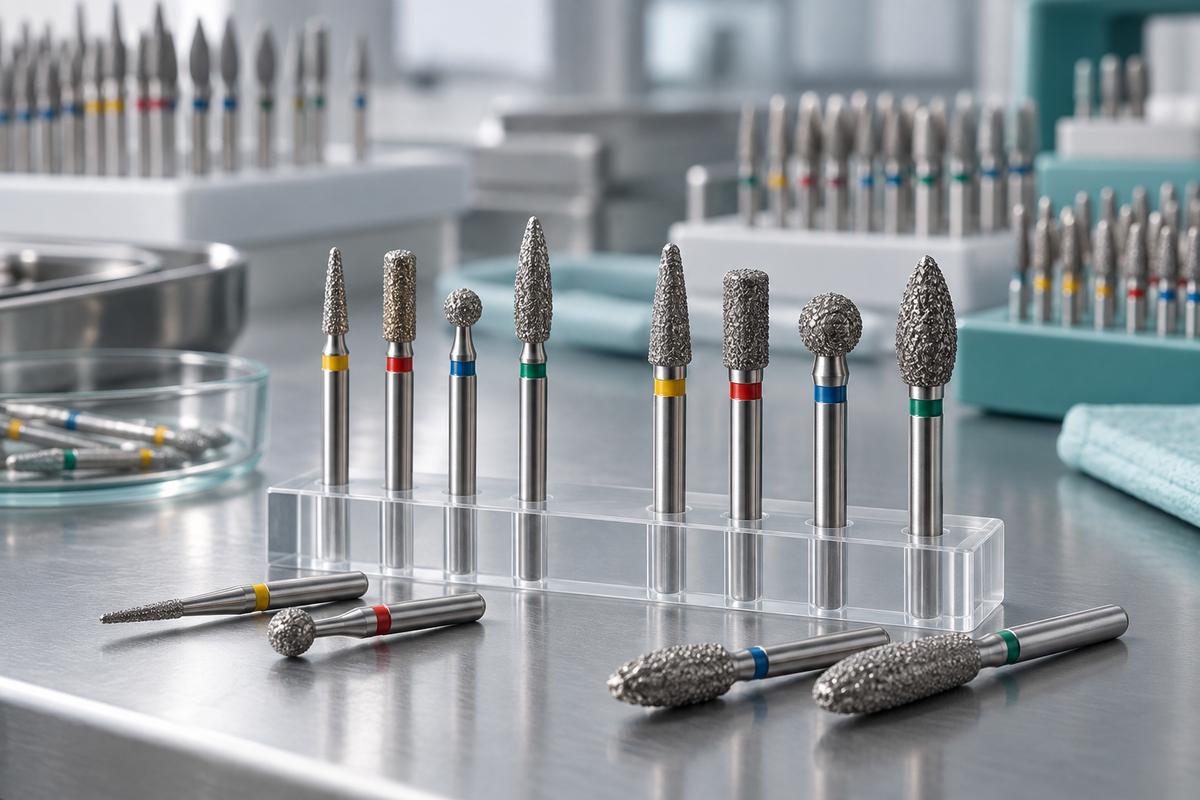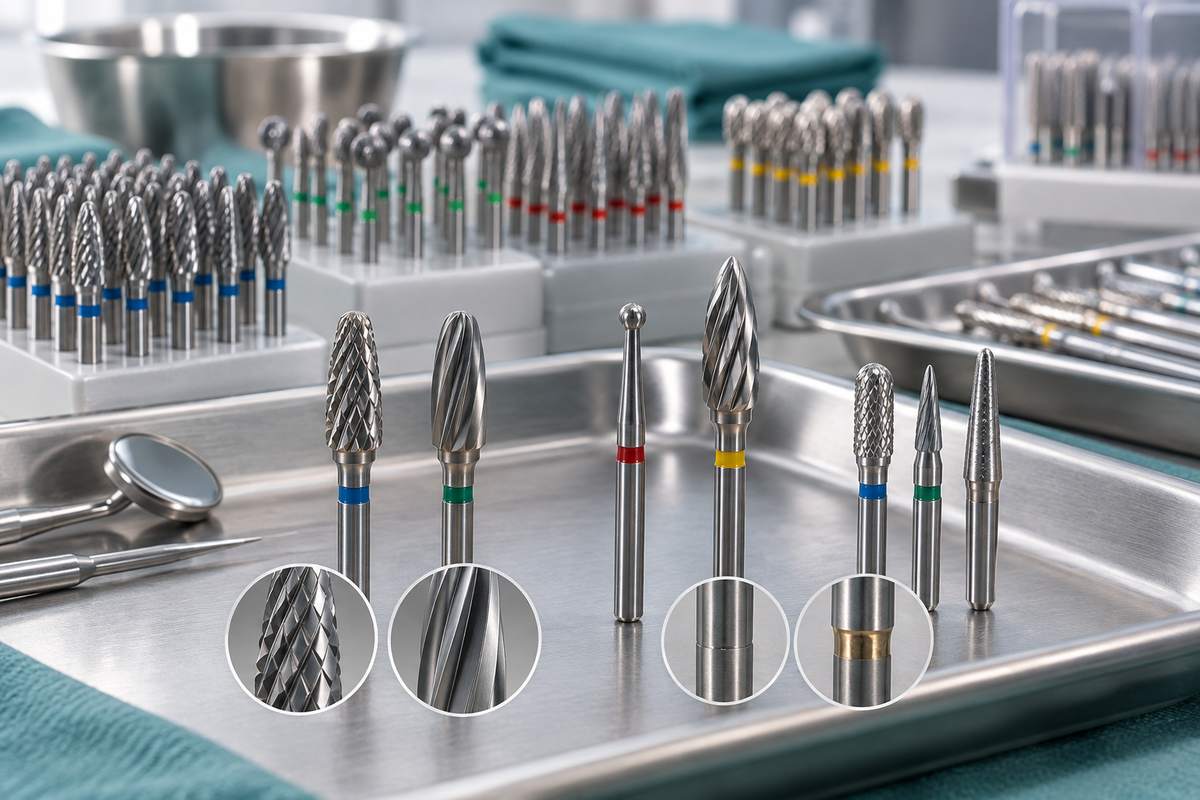
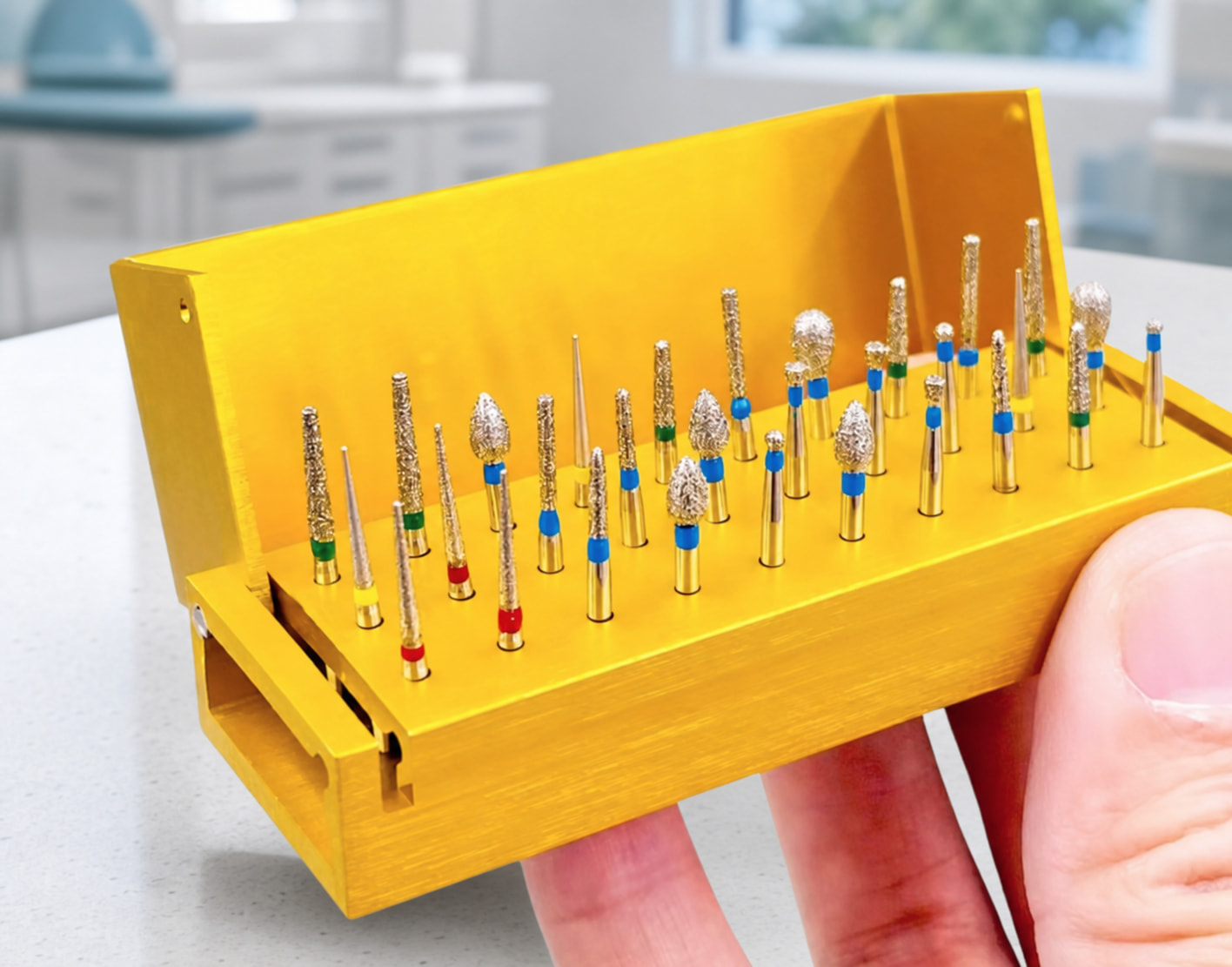
Opening a new operatory means deciding what goes in the bur block before the first patient sits down. Order too narrow a selection and you are back ordering mid-week; order everything in the catalog and you tie up cash in burs that sit unused. This is the working set we would put together for a new chairside setup, what each piece does, and how the parts fit the same workflow.
The Four Parts of a Working FG Set
A functional chairside set covers four jobs: cutting, finishing, maintenance, and storage. Miss any one and the other three get more expensive. Cutting burs shape the tooth, polishers bring the restoration to a finish right after prep, a dressing stone keeps the burs cutting instead of being thrown out early, and a block keeps everything organized through the autoclave.
All four use the FG (friction grip) shank, which fits standard high-speed handpieces. Confirm your handpiece type before ordering — an RA or HP shank will not seat in a high-speed head, and shank mismatch is the most common and most avoidable ordering mistake we see from new accounts.
Cutting: Diamond Burs
Start with a coarse, medium, and fine spread rather than several shapes in one grit. That covers crown preparation, cavity preparation, and general chairside cutting without switching bur families mid-procedure.
From the Diamond Burs range, 001-008S, 001-010M, and 001-012M make a reasonable three-bur starting point. Once you know which shapes your cases actually call for, it is easier to deepen the selection than to guess up front.
Finishing: Rubber Polishers
Polishing happens immediately after prep, so the polishers need to be in the same block as the burs rather than in a drawer. Diamond Rubber Polishers smooth enamel and restorative margins before impression, bonding, or cementation, and run cool enough for intraoral use under light pressure.
SR101M, SR103M, and SR105M cover a pre-polish and final gloss sequence. For composite work specifically, the Silicon Polishing Burs For Composites range is purpose-built for a high-shine finish.
Maintenance: A Dressing Stone
A diamond bur that has stopped cutting is usually loaded, not worn out. Dressing it restores the cutting surface and buys back working life that would otherwise be thrown away. A single stone such as 1W from the Sharpening Stones range costs a fraction of the burs it keeps in service, which makes it the highest-return item on this list.
Storage: A Sterilisable Bur Block
Loose instruments in a tray get lost, mixed between patients, and damaged. An autoclavable block such as BB201 from the Bur Block Sterilisable Alluminum/Plastic range holds the burs and polishers through the full sterilization cycle and makes chairside setup faster between procedures.
Trying Before You Commit
If you would rather evaluate shapes and grits against your own cases before settling on a standard set, a Samples Collection / Burs Folder lets you compare several options side by side. For a clinic outfitting a room from scratch, the Clinic Kits range bundles instruments across the stages above into a single order.
Standardizing Your Restock
The advantage of settling on a defined set is the reorder. Once a clinic has run through its first set, restocking becomes one request instead of rebuilding an order across four categories every cycle. Dealers serving smaller clinic accounts often work the same way, standardizing on one combination so inventory stays predictable across burs, polishers, stones, and blocks.
Frequently Asked Questions
How many burs does a new clinic actually need to start? A coarse, medium, and fine diamond bur plus two or three polishers will handle most routine chairside work. Add shapes as your case mix tells you what is missing, rather than stocking broadly on day one.
Can I mix shank types in one bur block? Physically yes, but it invites mistakes. Keeping FG instruments in their own block avoids reaching for a bur that will not seat in the handpiece you are holding.
How long do diamond burs last? It depends on the material and how often they are dressed. Burs that are dressed regularly with a stone stay in service considerably longer than burs that are discarded the first time they feel dull.
Do I need separate polishers for composite and porcelain? Rubber polishers cover a broad range of restorative surfaces, but composite-specific polishers give a better final shine on composite restorations. Most clinics carry both once their case volume justifies it.
Are these available at wholesale pricing for a single clinic? Yes. Minimums are kept low so a single clinic can order a starting set without committing to distributor volumes.
Sourcing Wholesale
BurDental has manufactured dental rotary instruments since 2008, in an ISO 13485 factory, with CE marked diamond and carbide products. Wholesale orders ship worldwide, and OEM or private label packaging is available for dealers.
Every item mentioned above is available individually through the Dental Burs Wholesale hub, so you can build a mix that matches your own procedures rather than a fixed list. For help matching instruments to your case mix, or for a quote on a starting set, reach us on WhatsApp at +86 186 8057 1046.