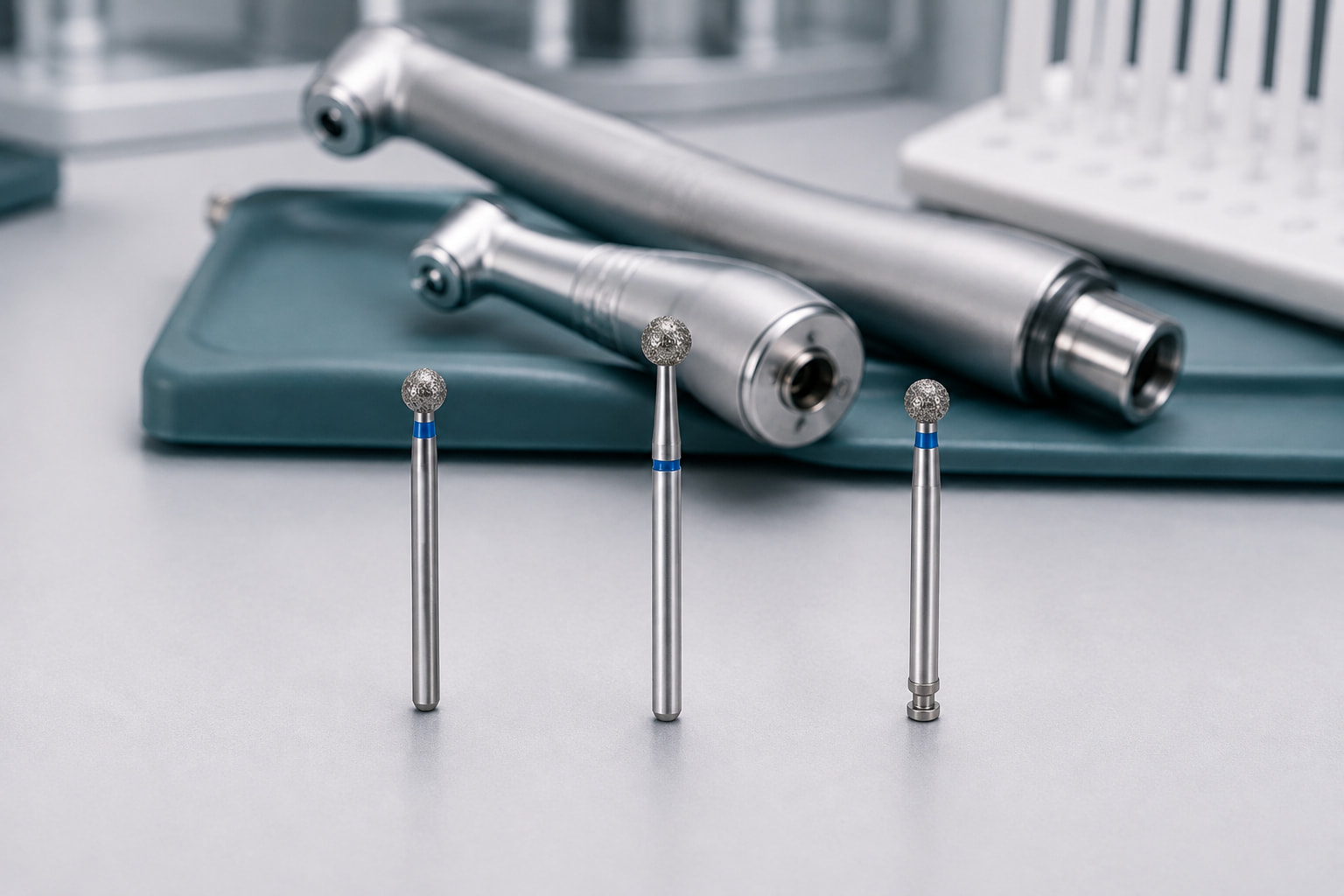
Selecting the correct dental bur begins with identifying the bur shank. Dental burs are manufactured with distinct shank geometries to match specific handpiece chucking mechanisms, operational speeds, and clinical or laboratory applications. Inserting an incompatible shank into a handpiece causes chuck slippage, bur runout, internal chuck damage, or tool ejection at high rotational speeds.
Wholesale purchasers, dental distributors, and clinic inventory managers must maintain standard stock across three primary bur shank types: Friction Grip (FG), Right Angle latch-type (RA), and Handpiece straight-shank (HP). Understanding the exact dimensions, locking mechanisms, and operational tolerances of each shank type ensures consistent procedural outcomes and extends handpiece chuck lifespan.
Friction Grip (FG) Shanks: High-Speed Clinical Burs
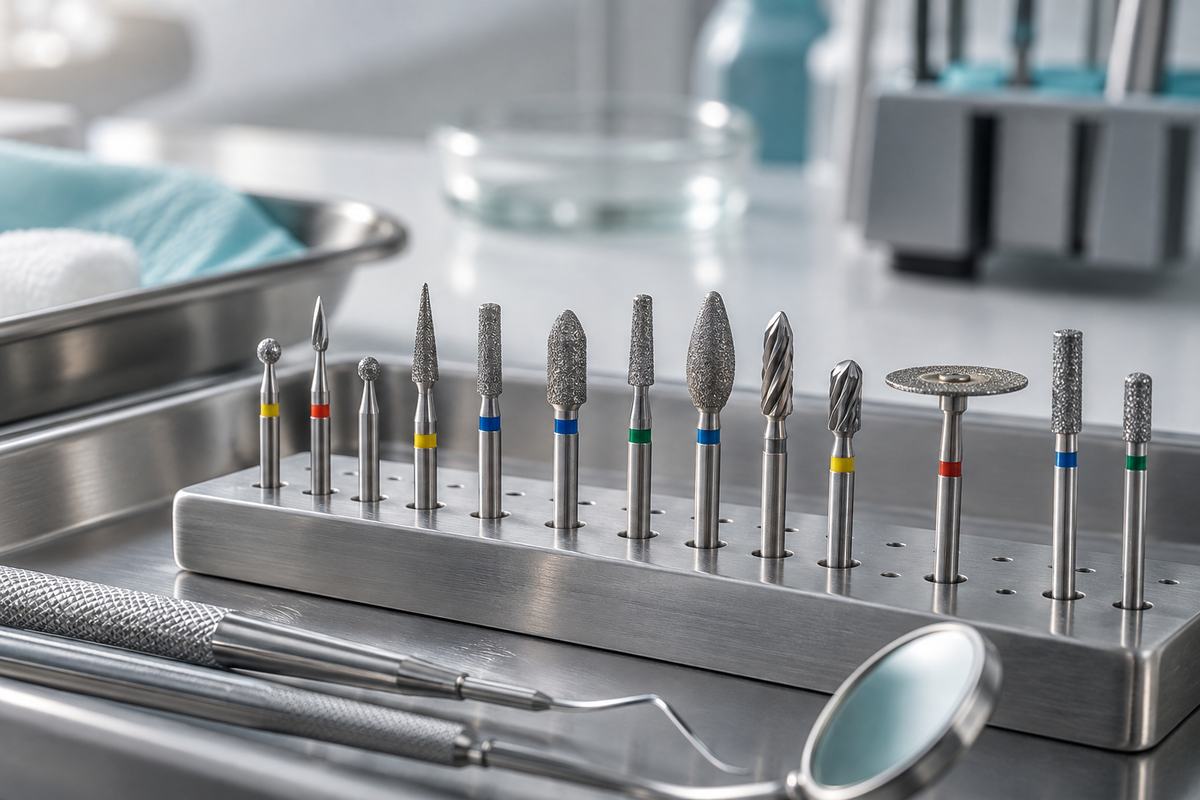
Friction Grip (FG) shanks are designed for high-speed air turbine and electric dental handpieces operating at speeds between 100,000 RPM and 450,000 RPM. The standard FG shank features a smooth, straight cylinder without notches or retention grooves. Handpiece chucks secure the bur solely through mechanical friction applied by a spring-loaded or push-button metal collet.
Standard FG shanks have a nominal diameter of 1.60 mm. The working length varies according to procedural access requirements:
- Standard FG: Overall length of 19 mm. Used for primary cavity preparation, occlusal reduction, and general restorative procedures using diamond burs such as 001-010M and 001-012M.
- FG Short Shank (FG SS): Overall length of 16 mm. Designed for pediatric dentistry and posterior access in patients with limited mouth opening.
- FG Surgical / Long Shank (FG L / FG Surg): Overall length of 25 mm. Provides extended reach for surgical extractions, crown sectioning, and endodontic access.
When purchasing FG burs in bulk, shank concentricity and diameter tolerance are critical quality metrics. If the shank diameter falls below 1.59 mm, the handpiece chuck cannot generate sufficient retention force, leading to bur slippage under cutting load. If the diameter exceeds 1.61 mm, the shank forces open the chuck collet, causing premature wear to handpiece bearings and chucking assemblies.
Right Angle (RA / CA) Latch-Type Shanks: Low-Speed Clinical Applications
Right Angle (RA) shanks, also designated as Contra-Angle (CA) shanks, are engineered for low-speed contra-angle handpieces operating at speeds between 5,000 RPM and 40,000 RPM. Unlike FG burs, an RA shank does not rely entirely on friction to remain secured. Instead, the shank features a mechanical retention groove and a flat notch at the base.
The dimensions and retention design of RA shanks include:
- Shank Diameter: Nominal diameter of 2.35 mm (3/32 inch).
- Standard Length: Overall length of 22 mm.
- Retention Mechanism: A semi-circular notch at the terminal end fits into a rotating latch or push-button catch inside the low-speed contra-angle head. The flat surface transmits rotational torque directly from the drive shaft without relying on friction grip.
- RA Long / Surgical: Overall length of 26 mm to 30 mm for deep excavation and root canal refinement.
RA shanks are the standard format for slow-speed excavation, amalgam and composite finishing, and prophylaxis. Dental clinics pair RA burs with rotary polishers like diamond rubber polishers (such as SR101M) and finishing burs to smooth restoration margins without removing sound enamel or overheating the pulp.
Handpiece (HP) Shanks: Dental Laboratory and Extraoral Bench Work
Handpiece (HP) shanks are long, straight cylindrical shanks engineered for straight dental handpieces, laboratory micro-motors, and bench lathes. HP burs operate at low to medium speeds, typically from 5,000 RPM to 35,000 RPM, where dental technicians require extended reach and high rotational torque.
Standard HP shank specifications:
- Shank Diameter: Nominal diameter of 2.35 mm (3/32 inch), identical to the RA shank diameter.
- Standard Length: Overall length of 44 mm (approximately 1.75 inches).
- Retention Mechanism: Smooth cylinder clamped by a manual twist-collet or lever-operated laboratory chuck.
Because HP burs share the 2.35 mm diameter with RA burs, technicians occasionally confuse the two. However, HP shanks lack the rear latch notch and are twice as long as standard RA burs. Inserting a 44 mm HP bur into a clinical contra-angle is physically impossible due to length and lack of latch retention. HP burs are used for trimming acrylic denture bases, sectioning plaster models, grinding metal alloy frameworks, and contouring CAD/CAM restorations before final sintering.
Comparison of Dental Bur Shank Types
The table below outlines the core mechanical specifications, standard dimensions, operating speeds, and clinical applications for FG, RA, and HP bur shanks.
| Shank Type | ISO Designation | Diameter (mm) | Standard Length (mm) | Handpiece Type | Speed Range (RPM) | Primary Clinical / Lab Use |
|---|---|---|---|---|---|---|
| FG (Friction Grip) | ISO 314 | 1.60 | 19 | High-speed turbine / electric | 100,000 – 450,000 | Cavity prep, crown prep, bulk enamel reduction |
| FG Short Shank | ISO 313 | 1.60 | 16 | High-speed turbine | 100,000 – 450,000 | Pediatric access, restricted interocclusal space |
| FG Surgical | ISO 316 | 1.60 | 25 | Surgical high-speed handpiece | 100,000 – 450,000 | Odontotomy, root sectioning, bone removal |
| RA / CA (Latch) | ISO 204 | 2.35 | 22 | Low-speed contra-angle | 5,000 – 40,000 | Caries removal, finishing, composite polishing |
| RA Long (Endo) | ISO 205 | 2.35 | 26 | Low-speed contra-angle | 5,000 – 30,000 | Deep cavity excavation, endodontic access |
| HP (Laboratory) | ISO 104 | 2.35 | 44 | Straight handpiece / micro-motor | 5,000 – 35,000 | Acrylic trimming, model adjustment, lab grinding |
Common Shank Incompatibility Errors and Prevention
Mismatches between bur shanks and handpiece chucks lead to equipment damage and clinical downtime. Inventory managers and clinical staff should watch for four common procurement and handling errors:
- Attempting to run HP burs in low-speed contra-angles: Both HP and RA shanks share a 2.35 mm diameter, but HP shanks lack the retention groove required by latch-type heads. A straight HP bur cannot lock into a contra-angle handpiece.
- Placing RA burs in straight lab handpieces: While an RA bur fits into a 2.35 mm straight handpiece collet, the 22 mm length is often too short for lab tasks, and the notched end can reduce collet grip surface area.
- Using worn FG shanks in push-button turbines: Reusable FG burs that have undergone repeated autoclave cycles or chemical cleaning can develop shank surface erosion. A diameter reduction of just 0.02 mm allows the bur to slip or walk out during high-speed cutting.
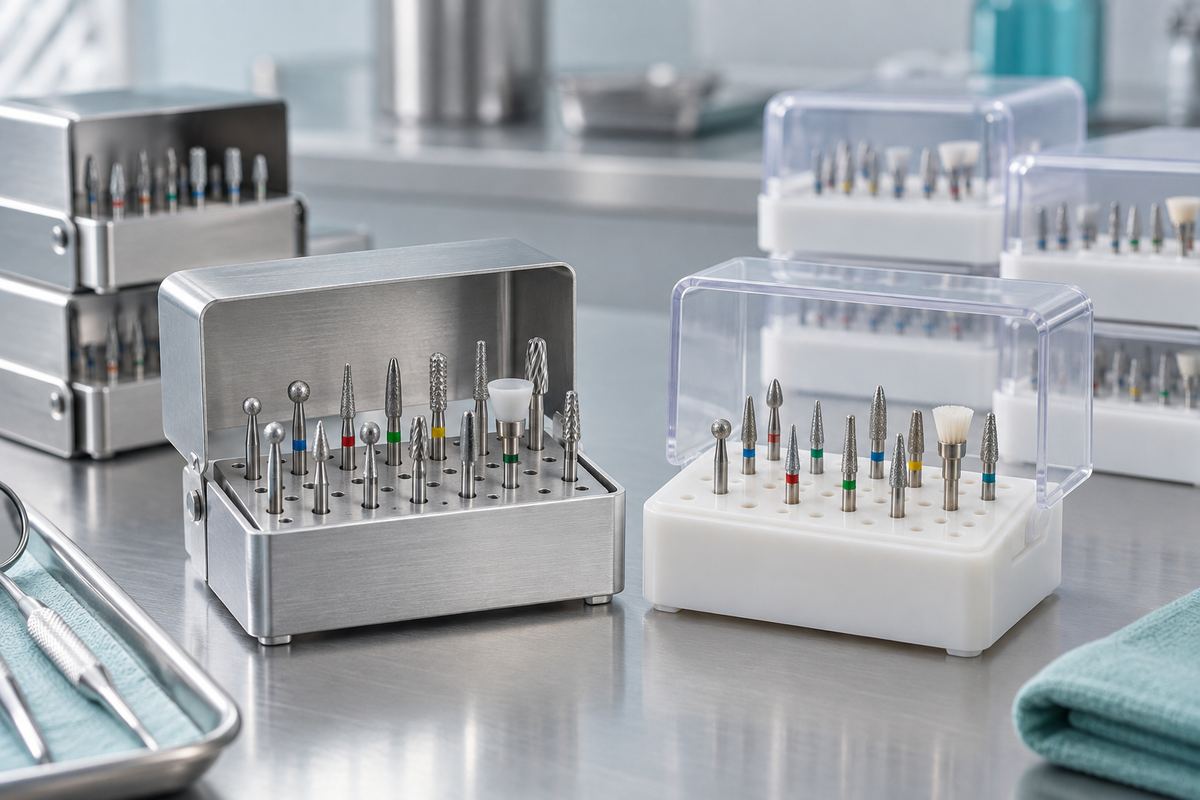
- Incorrect storage mixing shank formats: Clinics that store unsorted FG, RA, and HP burs together risk cross-contamination and selection errors. Organizing rotary inventory in labeled autoclavable storage blocks, such as bur block sterilisable holders (SKUs BB201, BB202, BB212), prevents shank mix-ups during tray setup.
For standardized clinical setups, purchasing pre-configured clinic kits (such as 4104 and 4105) ensures all burs match the practice handpiece standard (FG for high-speed preps and RA for slow-speed finishing).
Manufacturing Quality Standards for Wholesale Buyers
Wholesale buyers evaluating bur manufacturers must inspect three manufacturing criteria to ensure shank compatibility across customer handpiece fleets:
- Shank Concentricity (TIR): Total Indicated Runout (TIR) must remain under 0.01 mm along the entire shank length. High TIR produces handpiece vibration, irregular tooth preparation margins, and early turbine cartridge failure.
- Heat Treatment and Hardness: Stainless steel shanks must maintain a Rockwell hardness (HRC) between 45 and 50. Softer steel deforms under chuck pressure; overly hard steel becomes brittle and fractures at the neck-shank junction.
- Corrosion Resistance under Autoclaving: Premium burs use surgical-grade stainless steel shanks that resist oxidation during standard 134°C steam sterilization cycles.
BurDental operates an ISO 13485 certified manufacturing facility founded in 2008, producing CE marked dental burs with precision-ground FG, RA, and HP shanks. Factory-direct orders, custom packaging and private label OEM options are available for dental dealers. Direct inquiries and bulk order requests can be submitted via WhatsApp at +86 186 8057 1046.
Frequently asked questions
Can an FG bur fit into an RA contra-angle handpiece?
No, an FG bur has a 1.60 mm shank diameter, which is too small for a standard 2.35 mm RA chuck. Using an FG bur in a contra-angle requires a dedicated FG-to-RA adapter sleeve or an interchangeable FG contra-angle head.
What is the diameter difference between FG and RA burs?
FG (Friction Grip) burs have a shank diameter of 1.60 mm, whereas RA (Right Angle) burs have a shank diameter of 2.35 mm. FG shanks are smooth cylinders for high-speed turbines, while RA shanks feature a mechanical latch groove for low-speed handpieces.
Why do some FG burs slip inside the high-speed handpiece chuck?
FG bur slippage occurs when the bur shank diameter is manufactured below the 1.59 mm tolerance limit or when the handpiece chuck spring mechanism is worn. Regular bur replacement and chuck retention testing prevent slippage during operative procedures.
Can RA latch burs and HP lab burs be used interchangeably?
No, RA and HP burs cannot be used interchangeably despite sharing a 2.35 mm diameter. RA burs are 22 mm long with a mechanical latch notch for contra-angles, while HP burs are 44 mm straight cylinders designed for straight lab handpieces.
How should clinics organize different bur shank types to avoid chairside errors?
Clinics should store burs by shank type in dedicated, labeled autoclavable bur blocks. Color-coded bur stands and pre-set procedure kits keep FG high-speed burs separated from RA low-speed finishing instruments.