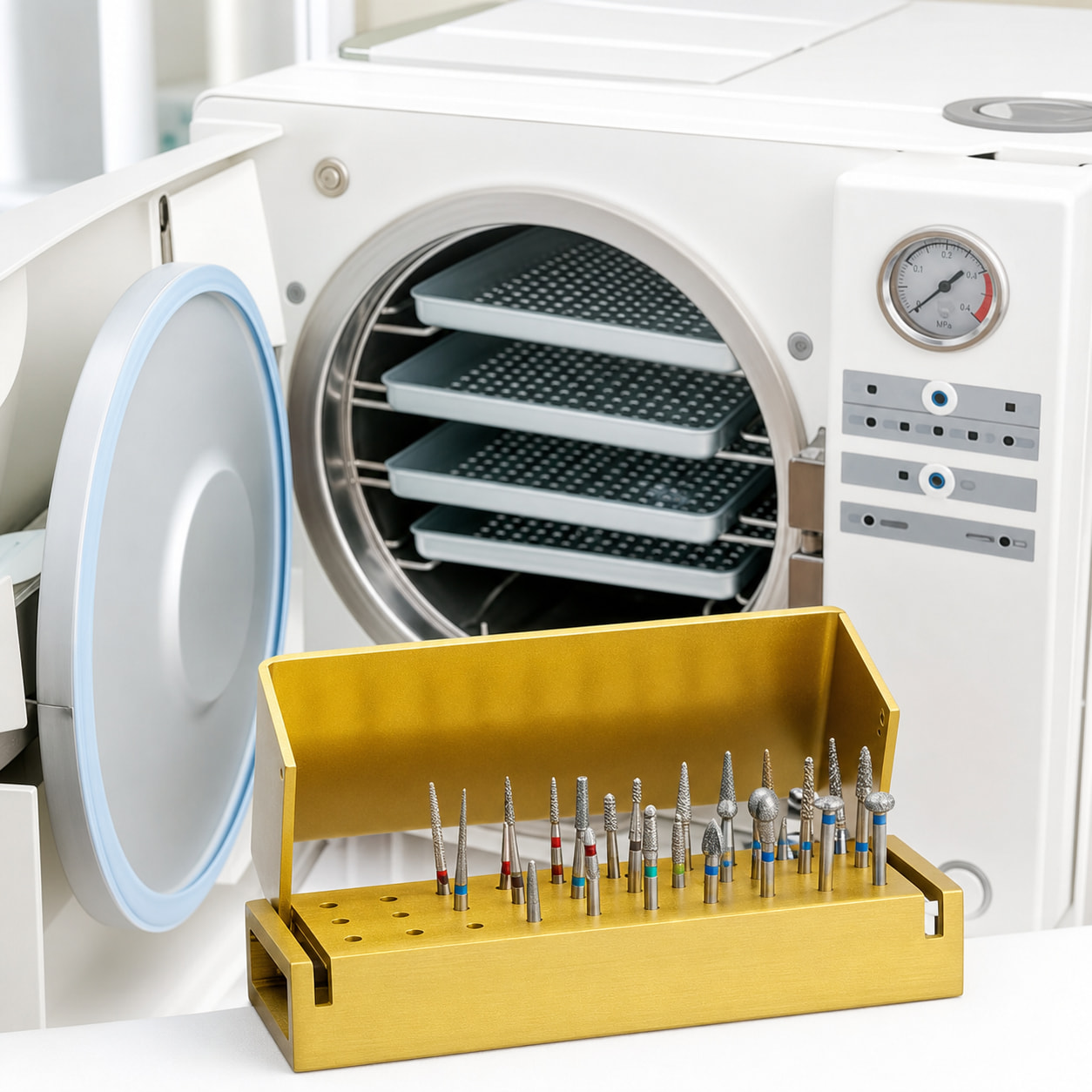
Buyers ask the same thing before a bulk order: will these burs still cut after a year of daily reprocessing. Steam is rarely what kills a carbide bur. Tungsten carbide is chemically stable and holds its hardness at sterilizer temperatures, so the cutting edge that goes into the chamber comes out the same hardness it went in with. What fails first is everything around the carbide: the joint where the head meets the shank, the steel of the shank, and the water and drying conditions inside your sterilizer.
That distinction matters when you compare quotes. Two burs can look identical in a product photo and behave very differently after a year in a clinic that reprocesses every instrument. What follows is what a cycle does to bur construction, which builds hold up to it, and what to ask a supplier before you commit to a carton of sterilizable carbide burs.
What a sterilization cycle actually does
A steam cycle puts the bur through heat, pressure and saturated moisture, then a drying phase that may or may not clear all the water out of the load. The carbide is unbothered by this. The cobalt binder holding the carbide grains together and the stainless steel of the shank are the parts that react.
Three failure modes show up in practice:
- Corrosion at the head-to-shank joint. Most FG and RA carbide burs are a carbide head brazed onto a steel shank. Water sitting in that seam, particularly if your sterilizer runs on hard or chloride-heavy tap water, attacks the braze. The head loosens long before the blades are worn out.
- Spotting and rust on the shank. A low-grade or roughly finished shank picks up rust after repeated wet cycles, and rust on one instrument spreads to the others sharing the same block or cassette.
- Residue baked into the flutes. Protein, composite and cement left on a bur before the cycle harden under heat and stay there. The bur is not dull, it is packed, but at the chair it behaves exactly like a dull bur.
None of that is the carbide losing its edge. Blade wear comes from cutting: contact with enamel, zirconia and alloy, plus side load and the wrong speed for the material.
Construction: what makes a bur survive repeat cycles
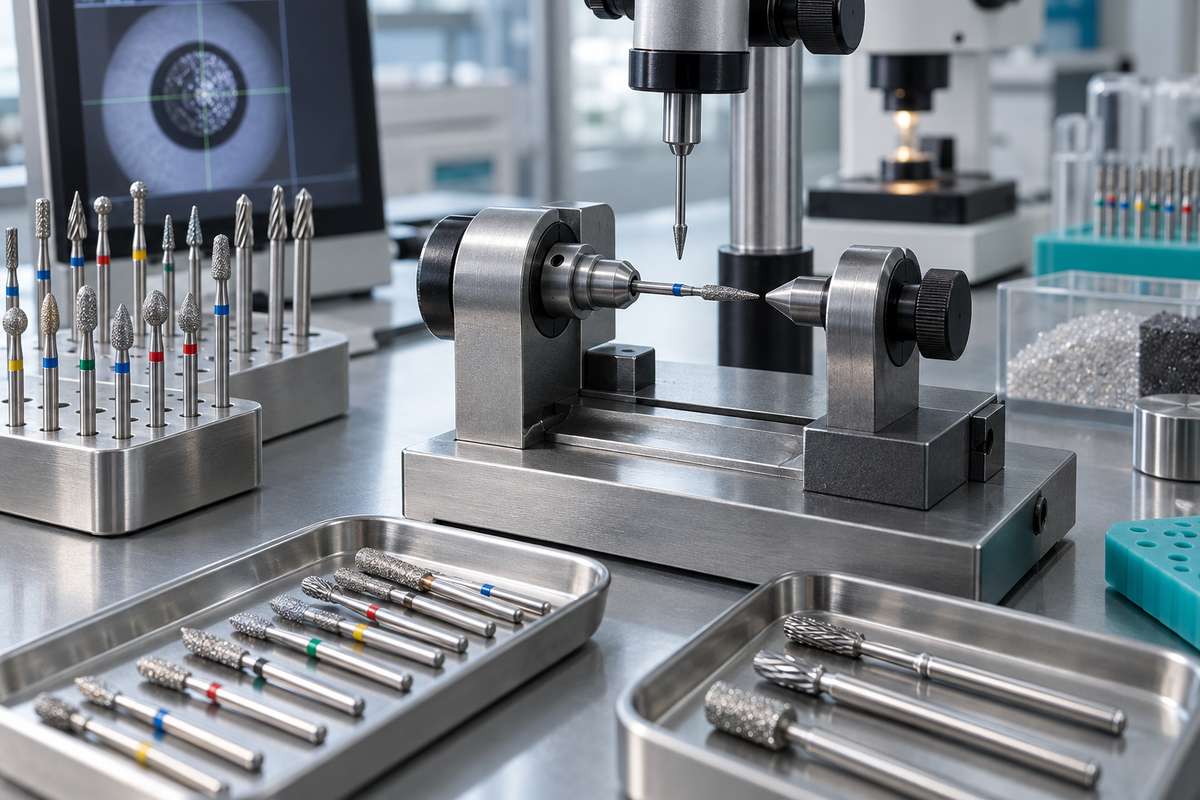
Ask how the head is attached before you ask anything else. Brazed construction is standard for tungsten carbide burs on a steel shank, and there is nothing wrong with it. A clean braze under a well-finished shank reprocesses for years. A poor braze with visible flux residue or a gap at the neck is exactly where water gets in.
| Construction | Where a cycle attacks first | Where it fits |
|---|---|---|
| Carbide head brazed to a stainless shank | The braze seam at the neck | FG and RA clinical cutting, surgical burs |
| One-piece carbide blank | Surface staining only, no seam to corrode | Lab trimming and heavy side-load work |
| Coated carbide | Coating wear at the flute edges | Finishing work, fast visual sorting |
Shank finish is the second thing to check. Run a fingernail down the neck of a sample: a polished, uniform shank sheds water during the drying phase, while a rough or matte shank holds it. That single difference explains most of the gap between a bur that lasts and a bur that spots within a month.
Coatings and what they are actually for
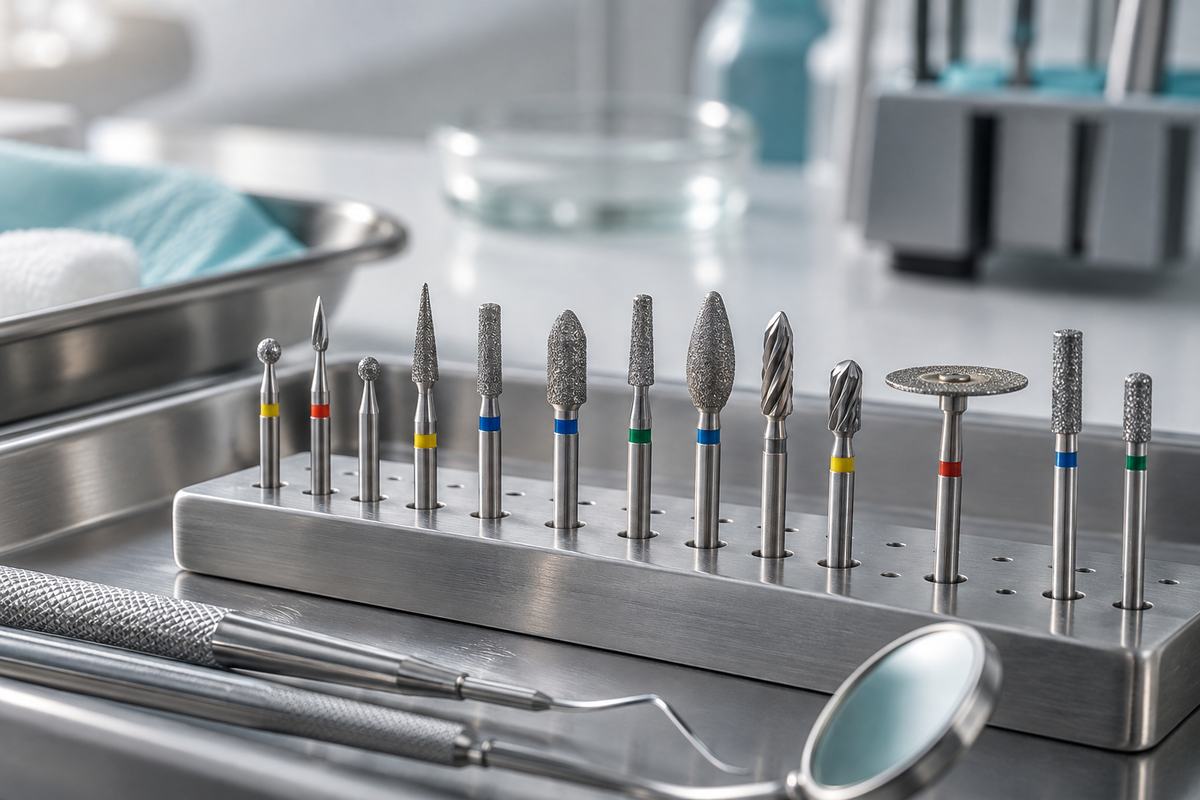
Gold-coloured and titanium-coloured coatings get sold as durability features. Treat them as cutting and identification features instead. A coating changes how the blade engages and gives your team a fast way to tell a finisher from a cutter in a loaded block, but it does not seal the braze joint, and once it wears at the working edges the substrate underneath is doing the job. When you buy trimming and finishing carbide burs, choose on blade count and shape, then judge reprocessing durability on the shank and the joint.
Shank type changes the picture
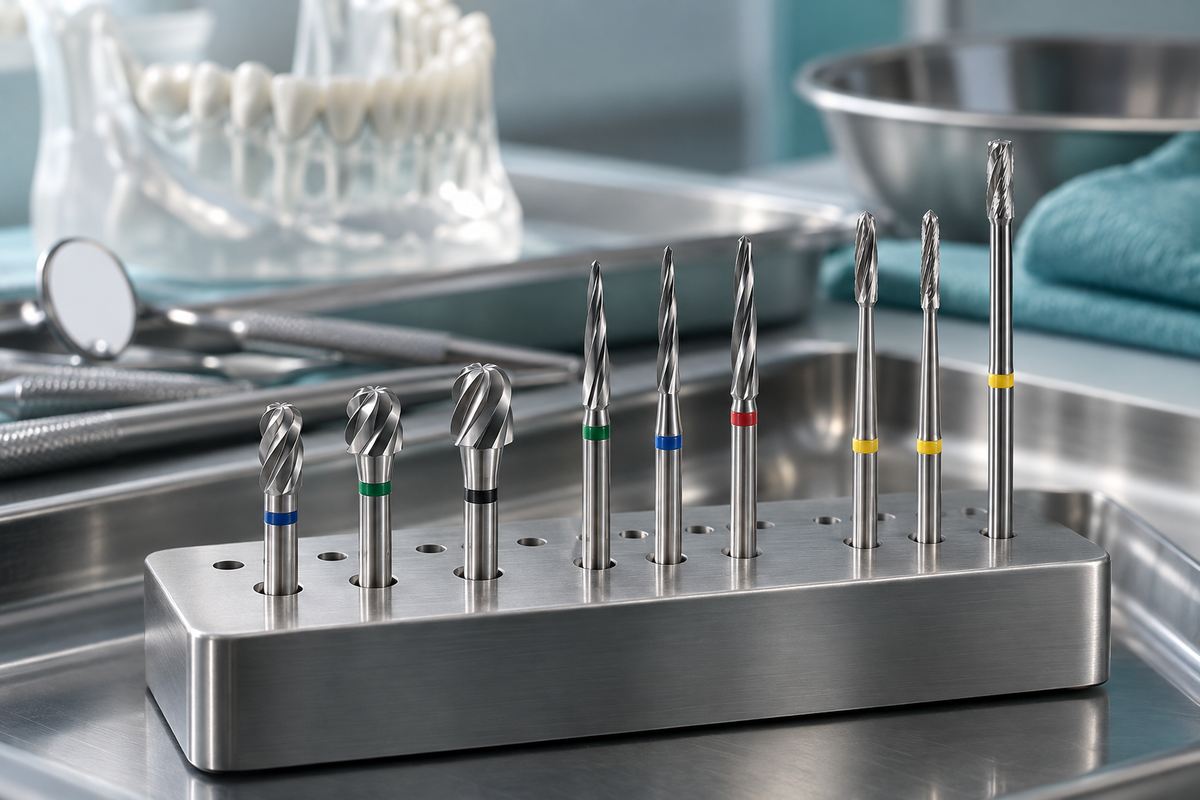
FG burs are short, live in blocks and go through the full clinical loop several times a week, so joint quality dominates their service life. RA burs sit in the same loop with more leverage on the neck. HP burs for the bench, including carbide burs for the lab handpiece, usually see cleaning rather than a full sterilization cycle, so their limit is blade wear from acrylic, alloy and plaster rather than corrosion. If one order mixes shank types, split the durability question the same way: clinical shanks are judged on corrosion, lab shanks on cut retention. The full range sits on the dental burs wholesale hub.
Storage and drying decide most of the outcome
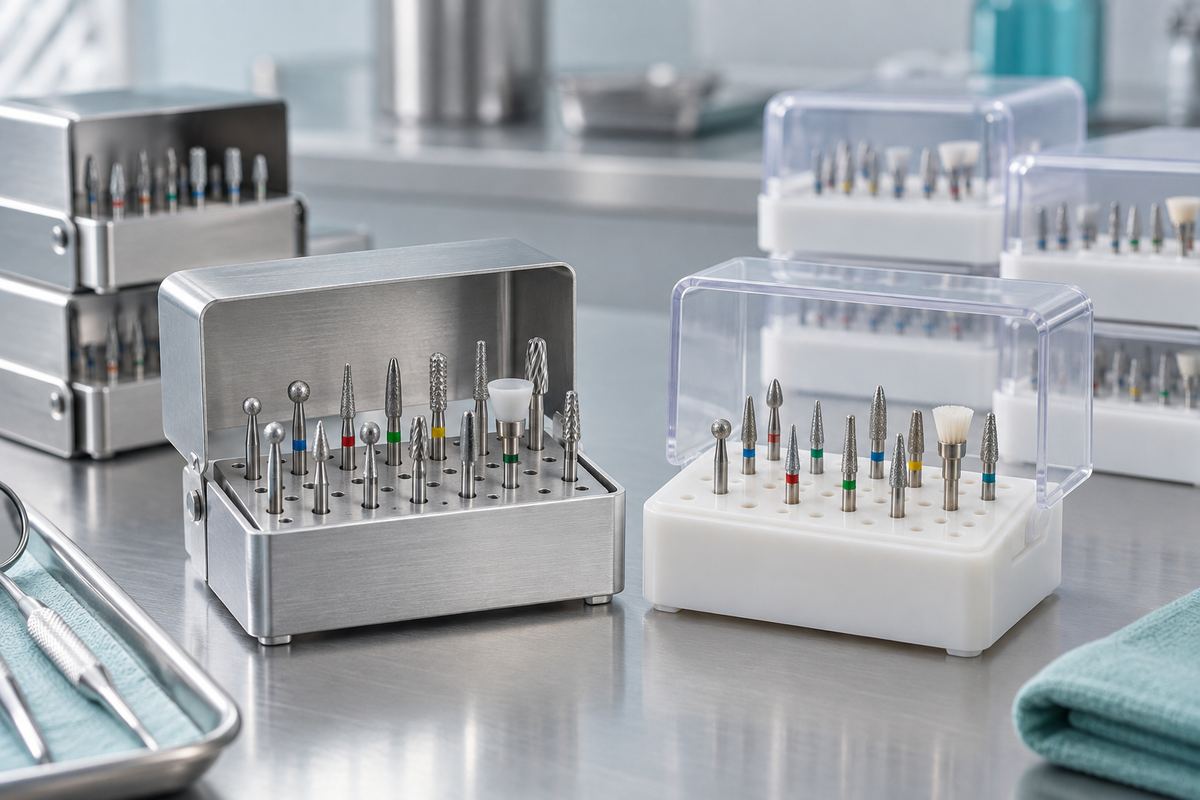
Most bur loss in a busy clinic happens after the cycle, not during it. Burs left in a closed cassette while still wet corrode at the neck, and burs tipped loose into a tray chip each other's blades. Sterilizable bur blocks such as BB201, BB202 and BB212 hold each bur upright and separated so water drains and the drying phase reaches the neck; aluminium and plastic bodies both take the cycle. Load the block with space between burs rather than filling every hole with the largest heads you own.
What to ask before a bulk order
- Is the head brazed or solid, and can the supplier send a close photo of the neck?
- What is the shank steel, and how is it finished?
- Is the product CE marked, and is it made in an ISO 13485 factory?
- Will they send a sample of the exact SKU, not a look-alike, so you can run it through your own sterilizer before committing?
- Is batch-to-batch consistency documented, so the second carton cuts like the first?
- Can they supply the same shape across FG, RA and HP if your clinic and your lab both order through you?
BurDental was founded in 2008 and makes its carbide range in its own ISO 13485 factory, CE marked and sold factory-direct to clinics, labs and dealers. Sample orders are welcome before a carton commitment, and quotes go out over WhatsApp +86 186 8057 1046.
Frequently asked questions
Can carbide burs be autoclaved?
Yes. Tungsten carbide holds its hardness through standard steam cycles, and sterilizable carbide burs are built for repeated reprocessing. Clean debris off before the cycle, because heat sets residue permanently.
How many times can a carbide bur be sterilized?
There is no fixed count. Replace on inspection and performance: blades that no longer bite, a head that wobbles, or corrosion visible at the neck. Your written reprocessing policy sets the ceiling.
Does autoclaving dull carbide burs?
No. Dulling comes from cutting, from side load and from running the wrong speed for the material. A bur that cuts poorly straight out of the sterilizer is usually clogged with baked-on residue or already worn.
Are coated carbide burs better for repeated sterilization?
Not inherently. Coatings affect cutting behaviour and sorting, not corrosion resistance at the braze joint. Judge autoclave durability on shank finish and joint quality.
Should single-use burs be reprocessed?
No. A bur marked single-patient-use by its manufacturer is not validated for reprocessing, and reusing it puts you outside the instructions for use. Keep reusable stock for routine work and order single-use items separately.
Buying for reprocessing is a construction question more than a cleaning question. Specify the joint, the shank and the storage, then run one box through your own sterilizer before the carton lands.