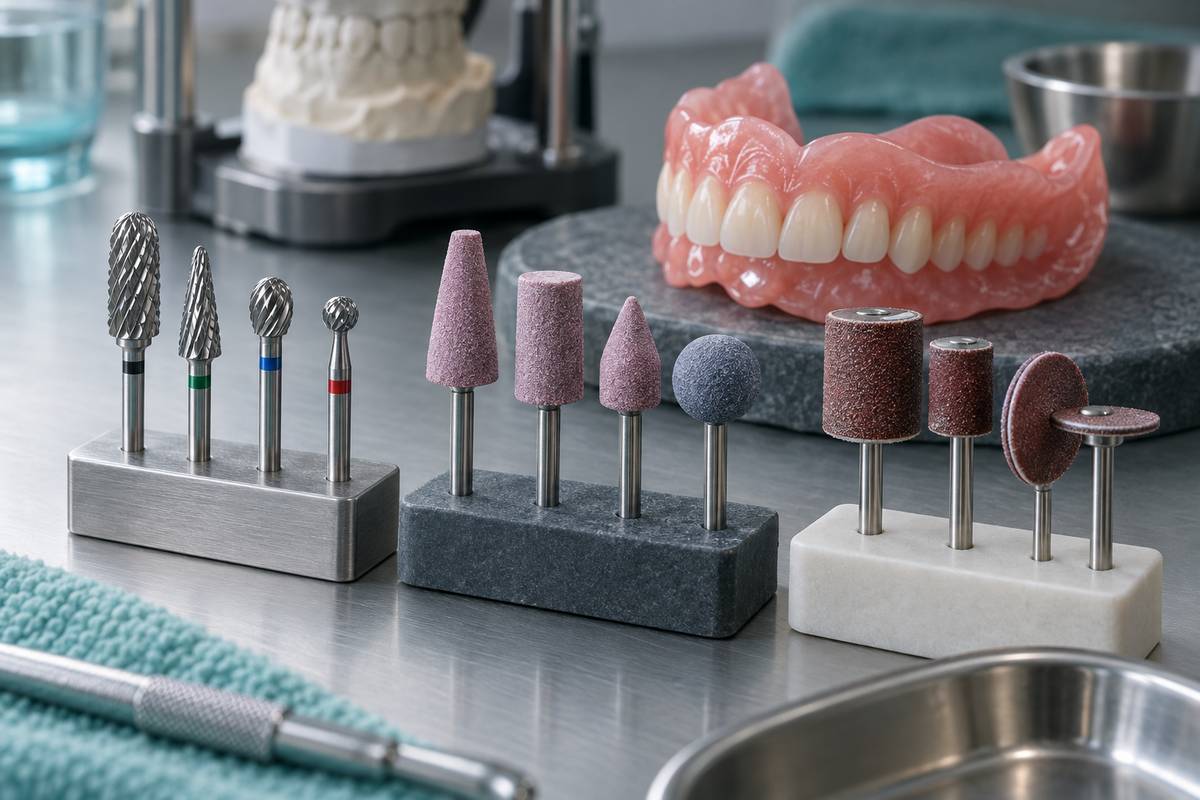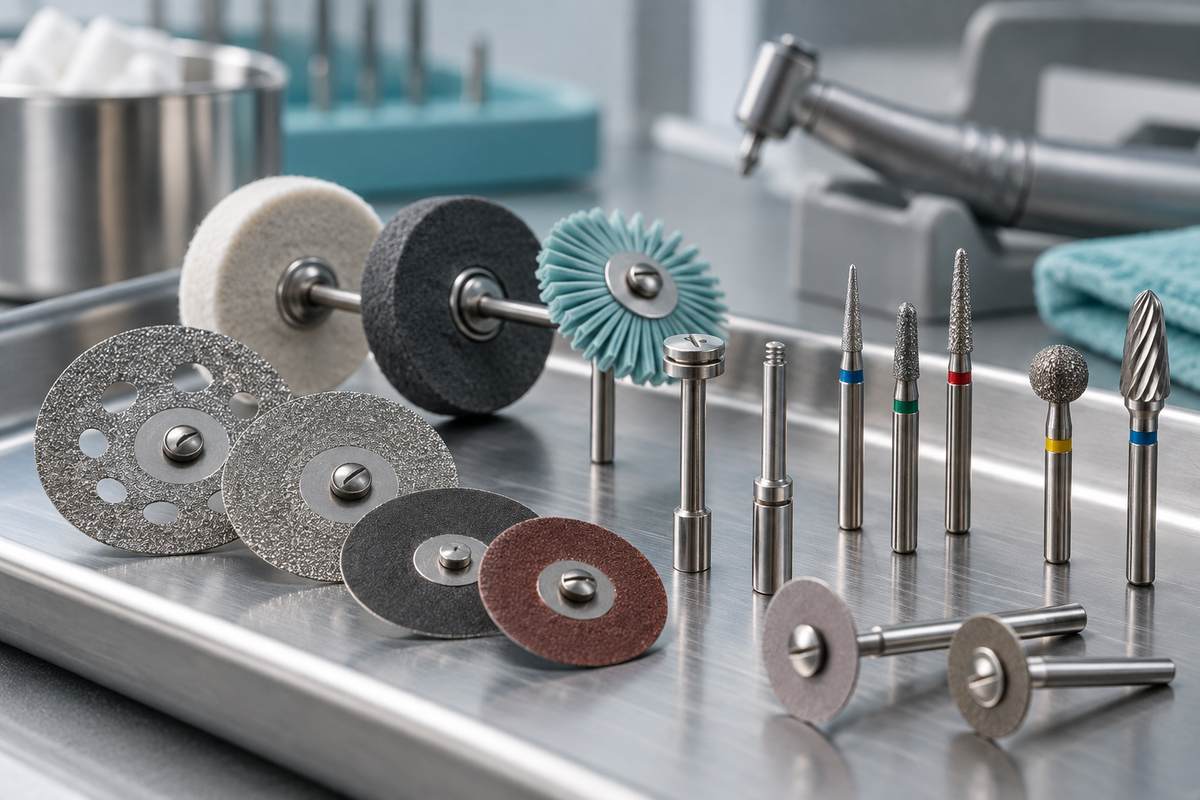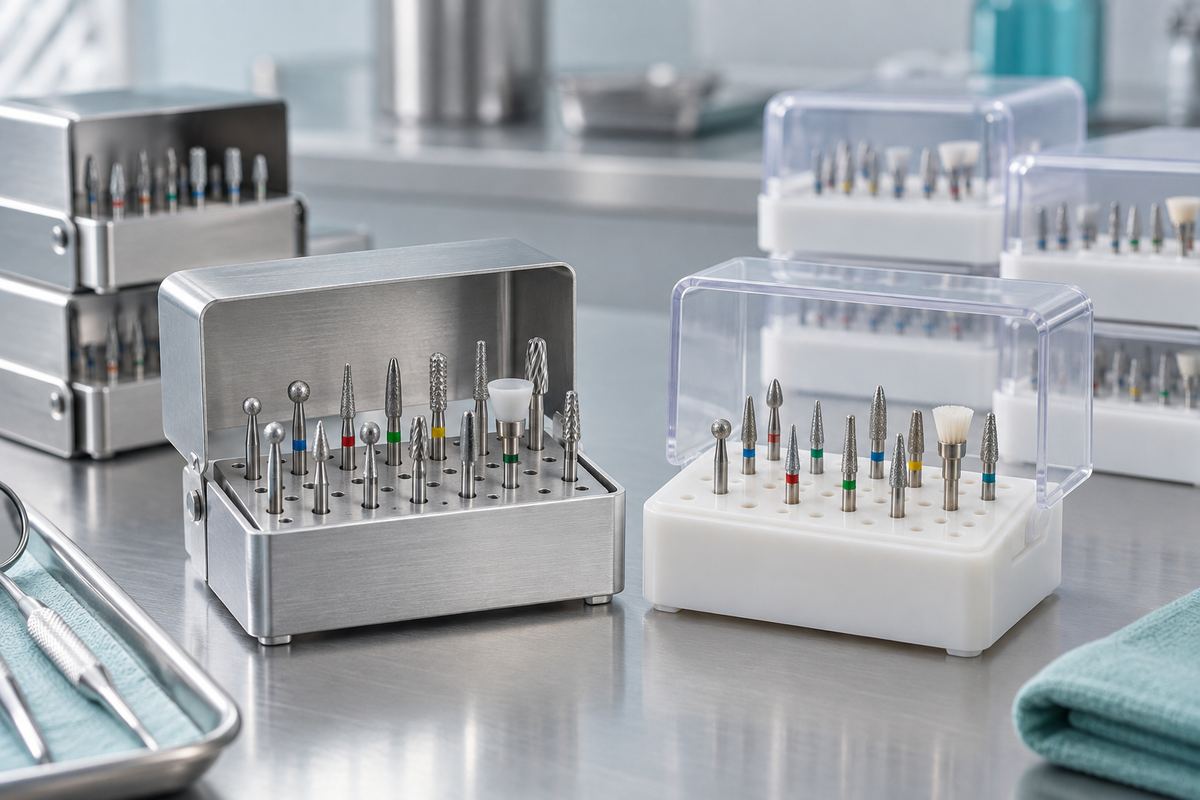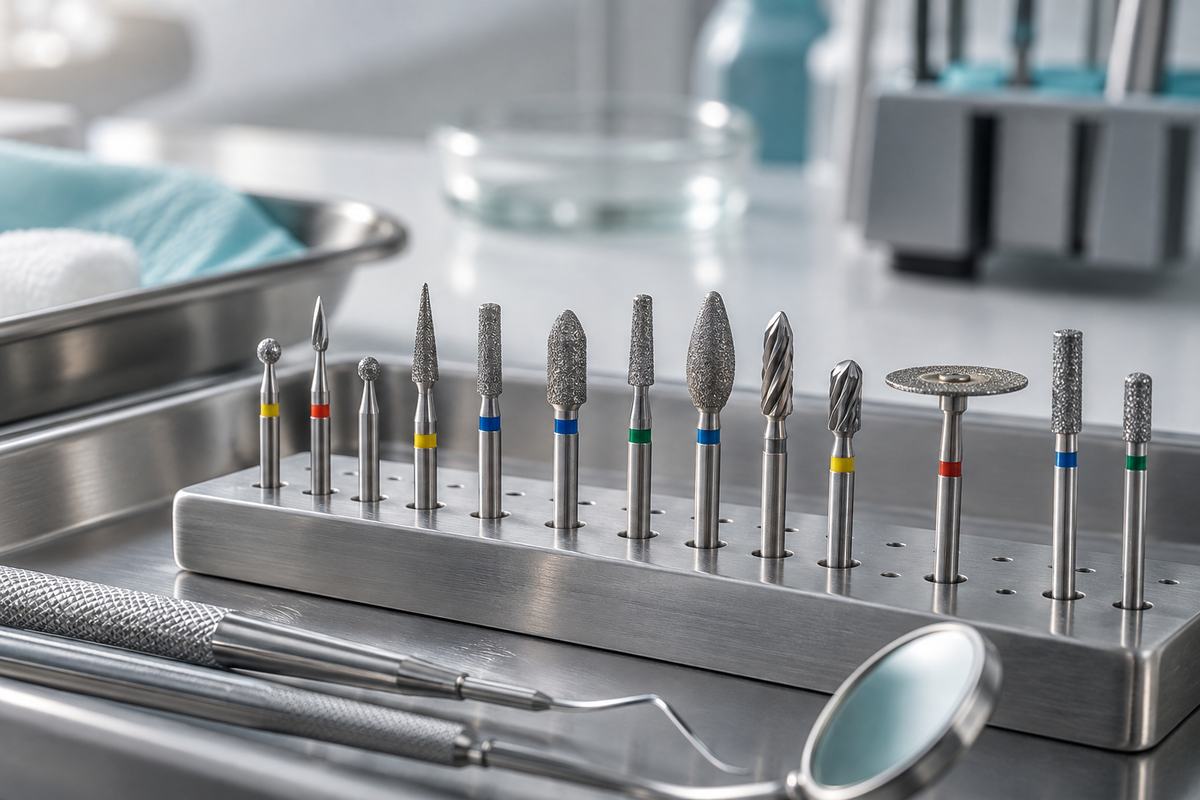
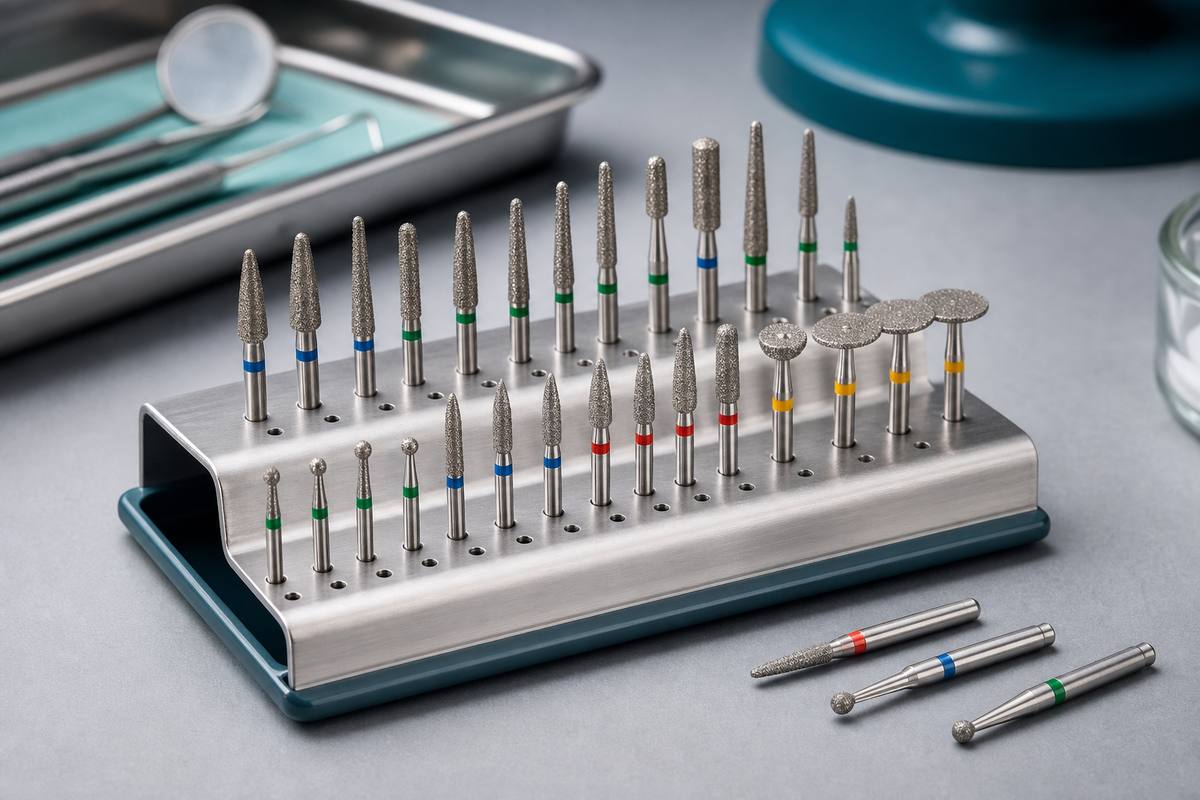
A diamond FG bur kit gets bought the wrong way more often than anything else in a clinic order. Someone picks an assortment box off a catalogue page, and by the end of the quarter the same few shapes are worn flat while half the block has never been in a handpiece. Building the kit around the procedures your chairs actually run fixes that, and it usually costs less.
This guide covers how to put a friction-grip diamond kit together procedure by procedure — crown and bridge prep, prep refinement, composite finishing, and zirconia adjustment — along with grit selection, storage, and what changes when you buy factory-direct instead of by the blister pack.
Build the kit from your procedure list
Start with a week of your own schedule. Write down every procedure that puts a diamond in the handpiece: crown preps, veneer preps, anterior and posterior composites, crown sectioning, ceramic adjustment at delivery. Put a rough count beside each one. That list is your kit.
Two clinics with the same monthly revenue end up with different blocks. A practice placing a lot of anterior composite needs fine and extra-fine grit in small heads and barely touches a coarse taper. A practice with a heavy crown and bridge schedule needs the opposite: coarse tapers in volume, a medium copy of each for refinement, and very little in the fine range.
Also write down how many chairs run at once. A kit is not one block: it is one block per chair, plus the spares that keep a chair working while the used block is in the autoclave.
Crown and bridge prep
Coarse grit earns its place in bulk reduction and margin work. For the prep side of the kit, stock:
- Round diamonds for access and depth orientation cuts. The 001 series covers this: 001-008S, 001-010M and 001-012M are the same round head in ascending sizes, which is enough spread for depth cuts through to access.
- Flat-end and round-end tapers in coarse grit for axial reduction and the margin. Order the shape you use every day in two head sizes rather than one of every shape in the catalogue.
- A wheel or football shape for occlusal and incisal reduction.
- A medium-grit copy of each taper for cleaning the prep before impression or scanning, since coarse grit leaves a surface the scanner has to work around.
Depth matters more than variety here. Coarse diamonds lose their bite fastest, so three or four of the taper that goes into every prep is a better order than one piece each of a dozen shapes you rarely reach for. All of these sit in the diamond burs range, and the same working shapes come golden coated if you want prep burs visually separated from finishing burs on a loaded block.
Finishing, contouring, and composite work
Fine and extra-fine diamonds handle the step between shaping and polishing: breaking line angles on a composite, blending a margin, opening embrasures, and taking the scratch pattern down to something a polisher can finish. Small flames, needles, and footballs cover most of that work.
Two rules keep this part of the kit small. Move one grit step at a time, because jumping from coarse straight to extra fine leaves scratches that only show up under the operatory light after the patient has been dismissed. And know where the diamond stops: once the contour is right, the surface belongs to silicone polishers, not to a finer bur. Clinics that finish composite with diamonds alone burn through fine grit and still hand back a dull surface.
Zirconia and glazed ceramic adjustment
Adjusting a sintered zirconia crown at delivery is a different job from cutting enamel, and a standard prep diamond is the wrong tool for it. The grit rounds over quickly, the margin chips, and the heat goes into the restoration instead of the cut. Keep a separate, clearly marked set of diamond burs for zirconia in the block, use light intermittent pressure with water, and let the bur cut rather than pushing it through.
That same set covers crown sectioning at removal, which is usually when a clinic finds out its zirconia burs are worn out.
A build sheet by procedure
Use this as the order sheet when you send a kit request to a supplier.
| Procedure | Grit band | Shapes to keep in the block | Category to order from |
|---|---|---|---|
| Crown and bridge prep | Coarse | Round, flat-end taper, round-end taper | Diamond Burs |
| Prep refinement before impression or scanning | Medium | The same tapers, one grit finer | Diamond Burs |
| Composite contouring and finishing | Fine and extra fine | Flame, needle, football | Diamond Burs |
| Zirconia and glazed ceramic adjustment | Coarse to medium, zirconia-specific | Taper, flame, wheel | Diamond Burs For Zirconia |
| High-volume prep days | Coarse | Your usual tapers, gold-colored for tray identification | Diamond Bur FG Golden Coated |
Storage, sterilization, and turnover
A kit is only as good as the block it lives in. Sterilizable aluminium and plastic blocks, BB201, BB202 and BB212 among them, hold burs by the shank so the heads never touch, which stops the grit-on-grit contact that dulls diamonds rattling loose in a drawer. Blocks from the sterilisable bur block range go through the autoclave with the rest of the tray.
Reuse policy is a local decision. Check the labeling for the specific bur and the rules in your market. Many clinics treat coarse diamonds as single-use because debris packs down between the grit and cutting efficiency does not fully come back after cleaning, while keeping fine and extra-fine diamonds in rotation for longer. Mark the block positions either way, so a worn bur gets replaced on a schedule instead of in the middle of a prep.
Ordering a diamond FG bur kit wholesale
Two routes work once the kit is settled. Pre-built clinic kits such as 4103, 4104 and 4105 are faster if the composition is close to your list. A custom kit — your shapes, your grits, your quantities — is the better option after a few months of knowing what your chairs consume, and it is where most repeat buyers end up.
Buying factory-direct changes the arithmetic. BurDental has run its own CE marked, ISO 13485 factory since 2008 and sells wholesale to clinics, labs and dealers, so kit composition, packaging and private labeling get decided with the people who make the burs. Minimums are low: send the shape list and quantities and ask for a quote rather than assuming you have to take a full carton of everything. Sample folders are available before a first order, and WhatsApp +86 186 8057 1046 is the fastest way to get pricing back.
Frequently asked questions
What goes into a diamond FG bur kit?
A working kit covers four jobs: coarse diamonds for reduction, medium for refining the prep, fine and extra fine for contouring composite, and a zirconia-specific set for adjusting delivered ceramic. Shape selection follows the procedures on your schedule, not the size of the assortment box.
How many burs of each shape should a clinic order?
Order depth in the two or three shapes that go into a handpiece every day, and single pieces of everything else. Most clinics under-order the coarse taper they reach for at every prep and over-order shapes that sit in the block for a year.
Can FG diamond burs be sterilized and reused?
It depends on the labeling for that specific bur and on the rules in your market, so check both. Many practices reuse fine diamonds after cleaning and autoclaving but treat coarse cutting diamonds as single-use, since packed debris and rounded grit cost more in chair time than a new bur costs to buy.
What is the difference between FG and RA diamond burs?
FG (friction grip) burs have a plain shank for the high-speed turbine handpiece, and RA (right angle) burs have a latch-type notched shank for the slow-speed contra-angle. A chairside diamond kit is almost entirely FG, with RA reserved for polishing and hygiene work.
Can you supply a diamond FG bur kit under our own brand?
Yes. BurDental produces private-label burs and kits in its own CE marked, ISO 13485 factory, including your choice of shapes, grits, blister or block packaging, and carton artwork. Send the shape list on WhatsApp +86 186 8057 1046 and ask for a quote; minimums are low.