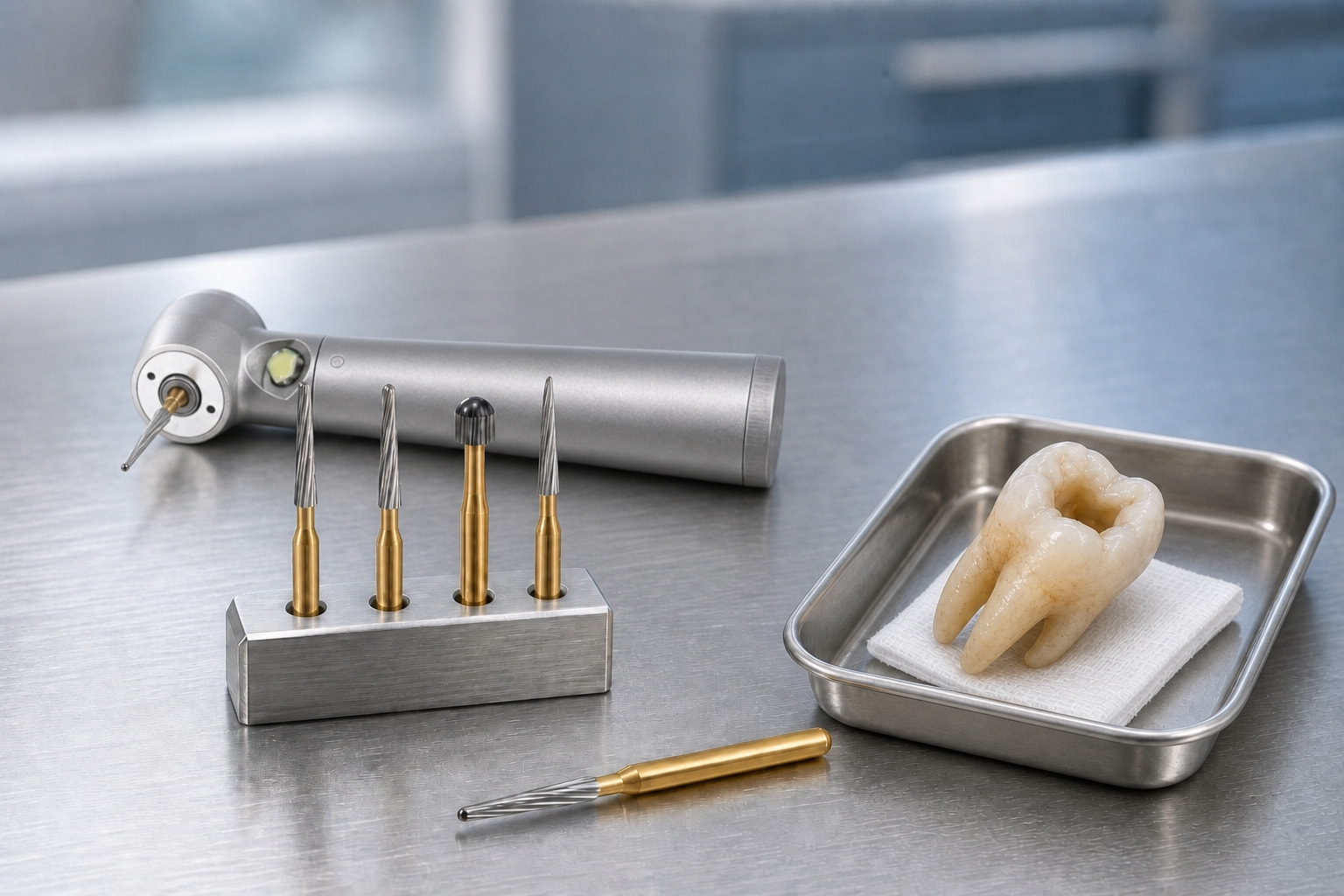
Endodontic access is the first hands-on step of every root canal procedure. The bur you choose for opening into the pulp chamber determines how cleanly you enter, how much tooth structure you preserve, and whether you risk perforating the floor. Despite this, many clinicians default to whatever round bur is closest at hand rather than selecting a bur matched to the tooth anatomy and clinical situation.
This guide covers the bur types used for endo access, explains how tooth anatomy should drive your selection, and lists the common mistakes that lead to perforations, ledges, and unnecessary tooth removal.
What makes endo access different from other prep work
Crown and bridge preparation removes enamel and dentin in predictable layers. Endo access, by contrast, requires the clinician to cut through existing restorations — metal, ceramic, composite — and then navigate through the roof of the pulp chamber, a structure whose depth and shape vary significantly by tooth type, patient age, and calcification status.
The access bur must do two things well: cut through the outer layer efficiently and allow controlled penetration into the pulp chamber without overshooting into the floor. That dual requirement is why endo access often calls for more than one bur during a single procedure.
For anterior teeth with straightforward anatomy, a single round diamond bur may be sufficient. Molars with calcified chambers or existing crowns typically require a sequence: an initial penetration bur, a shaping bur, and sometimes a finishing bur for refining walls.
Types of burs used for endodontic access
Several bur types see regular use in endo access. Each has strengths and trade-offs depending on the clinical scenario.
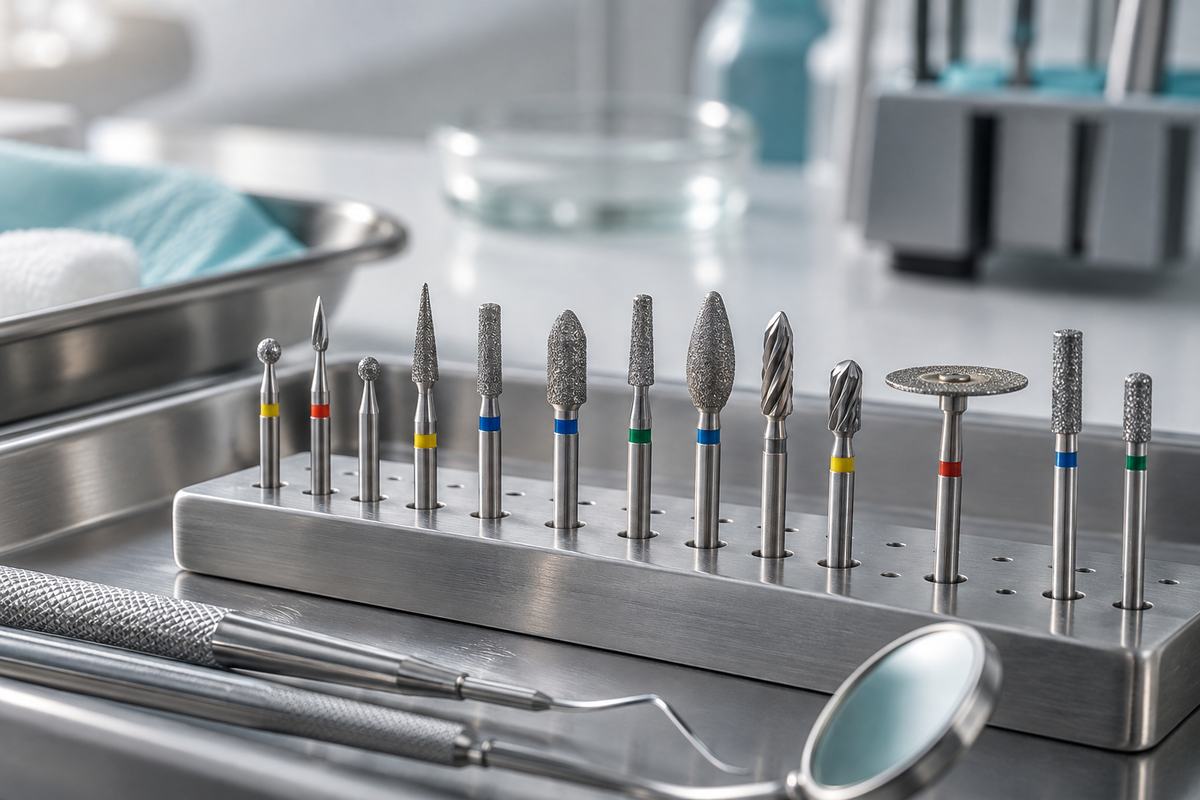
Round diamond burs are the workhorse for initial enamel and dentin penetration. Their spherical head cuts in all directions, making them forgiving during the initial entry phase. BurDental's round diamond burs such as the 001-010M (1.0 mm head, medium grit) and 001-012M (1.2 mm head, medium grit) are common choices for access openings. The medium grit provides efficient cutting without excessive vibration.
Round carbide burs offer a different cutting action. Where diamond grinds, carbide shears — producing cleaner cavity walls and better tactile feedback when you break through the roof of the pulp chamber. Many endodontists prefer a round carbide bur for the final penetration into the chamber because the distinct "drop" feel is easier to detect than with diamond.
Tapered fissure burs (170 and 171 shapes) are used to refine and straighten access cavity walls after the initial opening. Their tapered profile creates the slight divergence needed for straight-line access to the canal orifices. These burs are not for initial penetration — they excel at shaping and wall refinement.
Endo-Z burs are specialized non-end-cutting burs designed specifically for access refinement. The non-cutting tip protects the pulp chamber floor from perforation while the sides shape the cavity walls. This makes them particularly useful in molars where the distance between the access opening and the furcation is small.
| Bur Type | Head Shape | Cutting Action | Best Use | Floor Risk |
|---|---|---|---|---|
| Round diamond (001-010M) | Spherical | Grinding | Initial enamel and dentin entry | Moderate |
| Round carbide | Spherical | Shearing | Pulp chamber deroofing | Moderate |
| Tapered fissure (170/171) | Tapered cylinder | Shearing | Wall straightening | Low |
| Endo-Z | Tapered, safe tip | Shearing sides only | Final shaping, molar access | Very low |
Bur selection by tooth type
Tooth anatomy should dictate your bur sequence. A maxillary central incisor and a mandibular molar present very different access challenges.
Anterior teeth have a single canal and a relatively shallow pulp chamber. A round diamond bur in the 010 or 012 size handles both penetration and initial shaping. Start from the lingual surface at the cingulum area. Once through enamel and into dentin, switch to a round carbide if you want better tactile feedback for the chamber entry.
Premolars sit between anteriors and molars in complexity. The key challenge is the narrow buccolingual dimension, which increases perforation risk if the bur drifts. Use a smaller round bur (such as the 001-008S) for initial entry, then open with a 010 or 012 once you confirm your orientation. Premolars with two canals need an oval access outline — a tapered fissure bur helps elongate the preparation buccolingually.
Molars demand the most careful bur selection. The pulp chamber is wider but can be significantly calcified, and the floor sits close to the furcation. Start with a round diamond bur to penetrate through any existing restoration and the roof of the chamber. Once you confirm entry, switch to an endo-Z bur for wall refinement — the safe tip prevents accidental perforation of the chamber floor. For molars with full-coverage metal crowns, a coarse-grit diamond or a dedicated crown-cutting carbide may be needed for the initial layer.
Calcified canals represent a special challenge. In older patients or teeth with a history of trauma, the pulp chamber may be partially or fully obliterated with secondary dentin. Use a small round diamond bur (001-008S) under magnification and work in short, controlled strokes. Frequent radiographic checks help confirm depth and trajectory.
Bur maintenance and replacement during endo procedures
A dull bur during endo access is more than an inconvenience — it forces you to apply more pressure, which reduces tactile feedback and increases perforation risk. Diamond burs lose cutting efficiency as the grit wears, and round carbide burs develop micro-chips along their flutes with repeated use.
For practices handling a high volume of endo cases, stocking access burs in bulk keeps per-unit costs low and ensures a fresh bur is always available. BurDental supplies diamond burs and carbide burs factory-direct with CE marking and ISO 13485 certification.
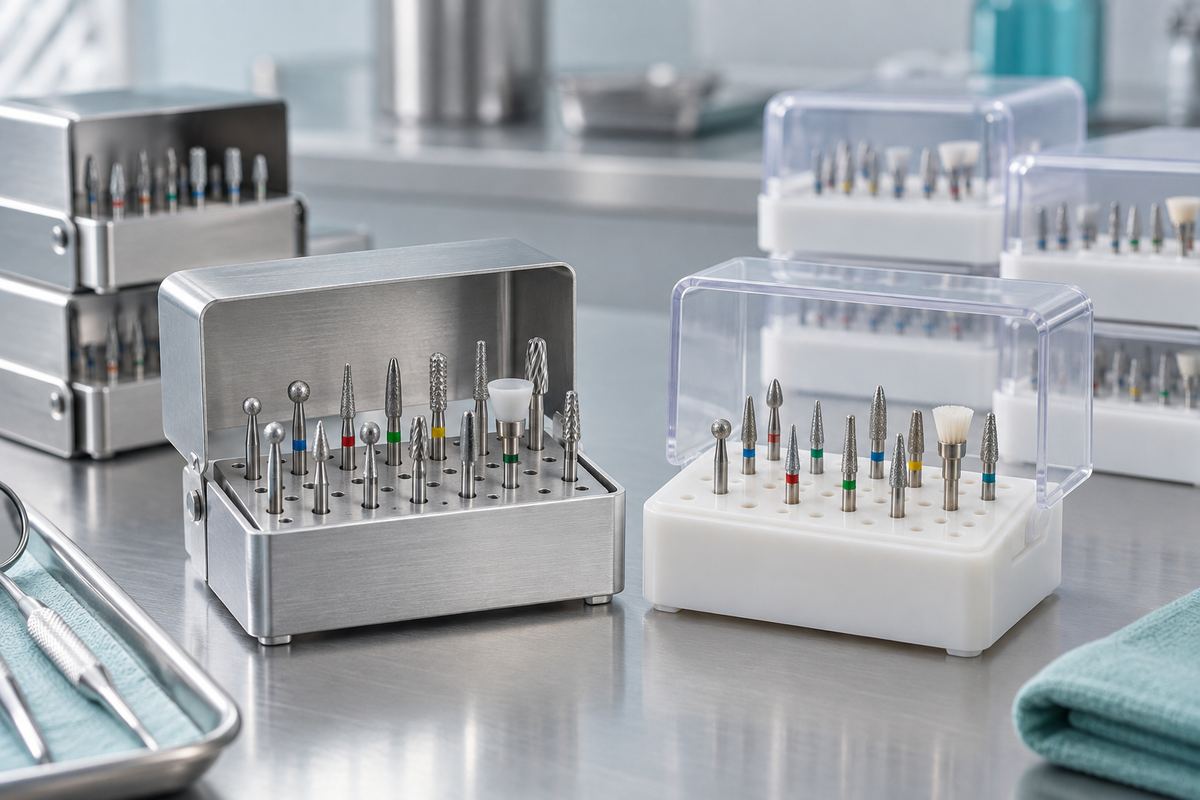
Organize your endo burs in a dedicated sterilizable bur block labeled by procedure. Keeping a preset sequence — round diamond, round carbide, tapered fissure, endo-Z — eliminates fumbling during the procedure and ensures you always reach for the right tool at the right stage.
Frequently asked questions
What size round bur is best for endo access?
A 1.0 mm (010) round bur works for most teeth. Use a 0.8 mm (008) for premolars and calcified chambers where precision matters more, and a 1.2 mm (012) for molars with larger pulp chambers. Start smaller and open up as needed — you can always remove more dentin, but you cannot replace it.
Should I use diamond or carbide burs for endo access?
Both have a place in the sequence. Diamond burs cut through enamel and existing restorations efficiently. Carbide burs give better tactile feedback when approaching and entering the pulp chamber. Many endodontists start with diamond for the outer layers and switch to carbide for the chamber deroofing.
How do I avoid perforating the pulp chamber floor?
Use an endo-Z bur for final shaping — its non-cutting tip cannot perforate the floor. During initial penetration with a round bur, stop frequently to check depth with an explorer or periapical radiograph. Know the average chamber depth for the tooth type you are treating and stay aware of calcification that may shift expected landmarks.
Can I buy endo access burs in bulk at wholesale pricing?
BurDental offers factory-direct wholesale pricing on all diamond burs and carbide burs with low minimums. The factory is CE marked with ISO 13485 certification. Contact the team via WhatsApp at +86 186 8057 1046 for bulk quotes and sample requests.