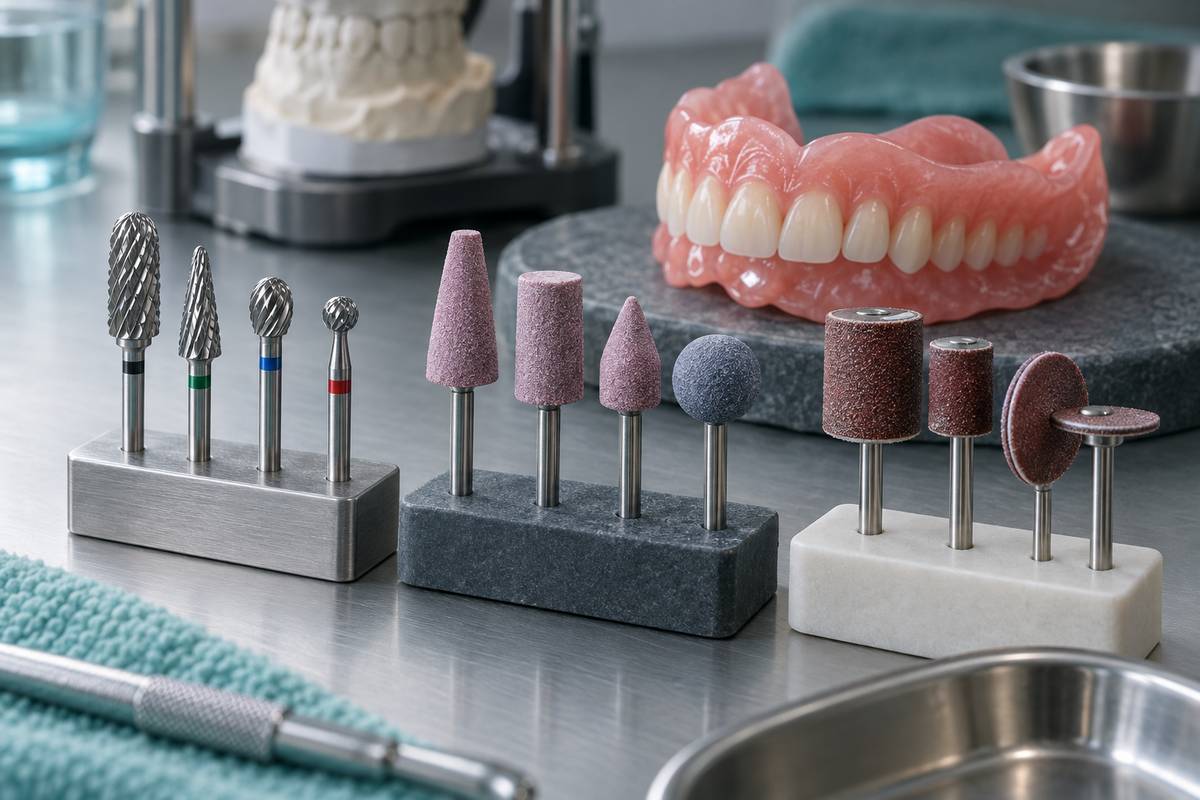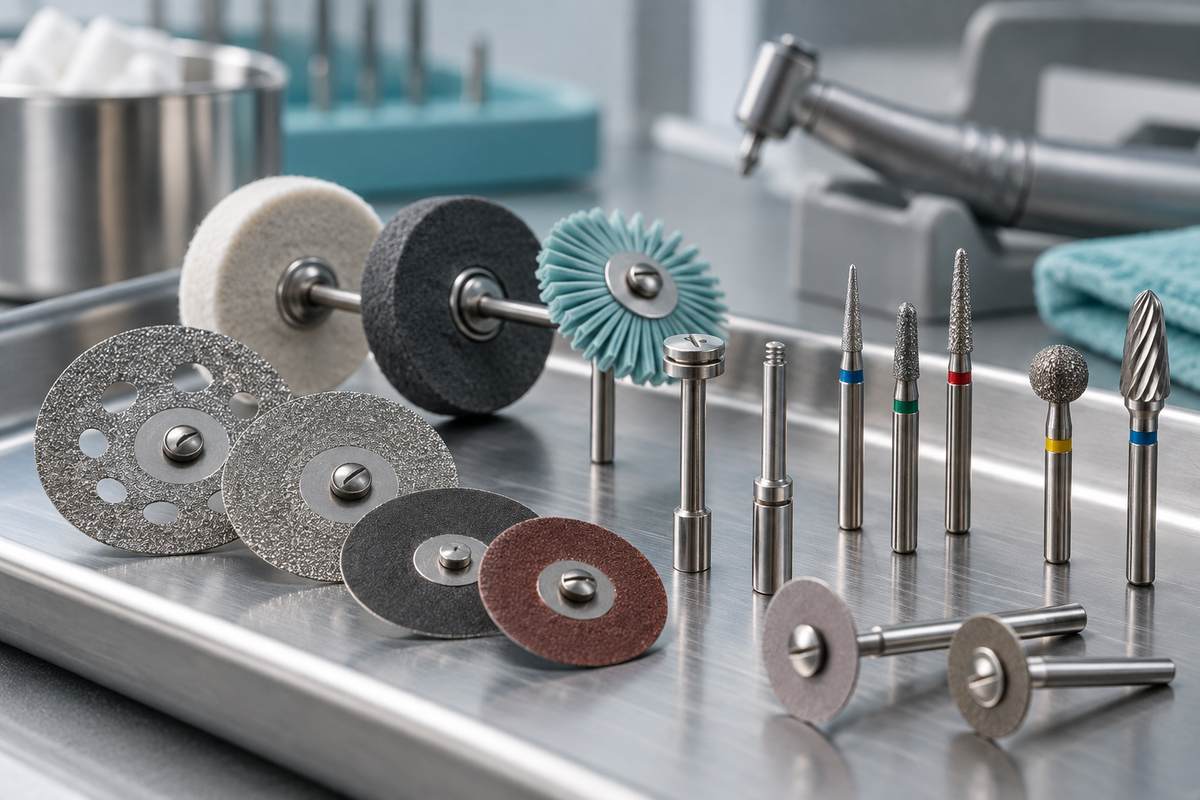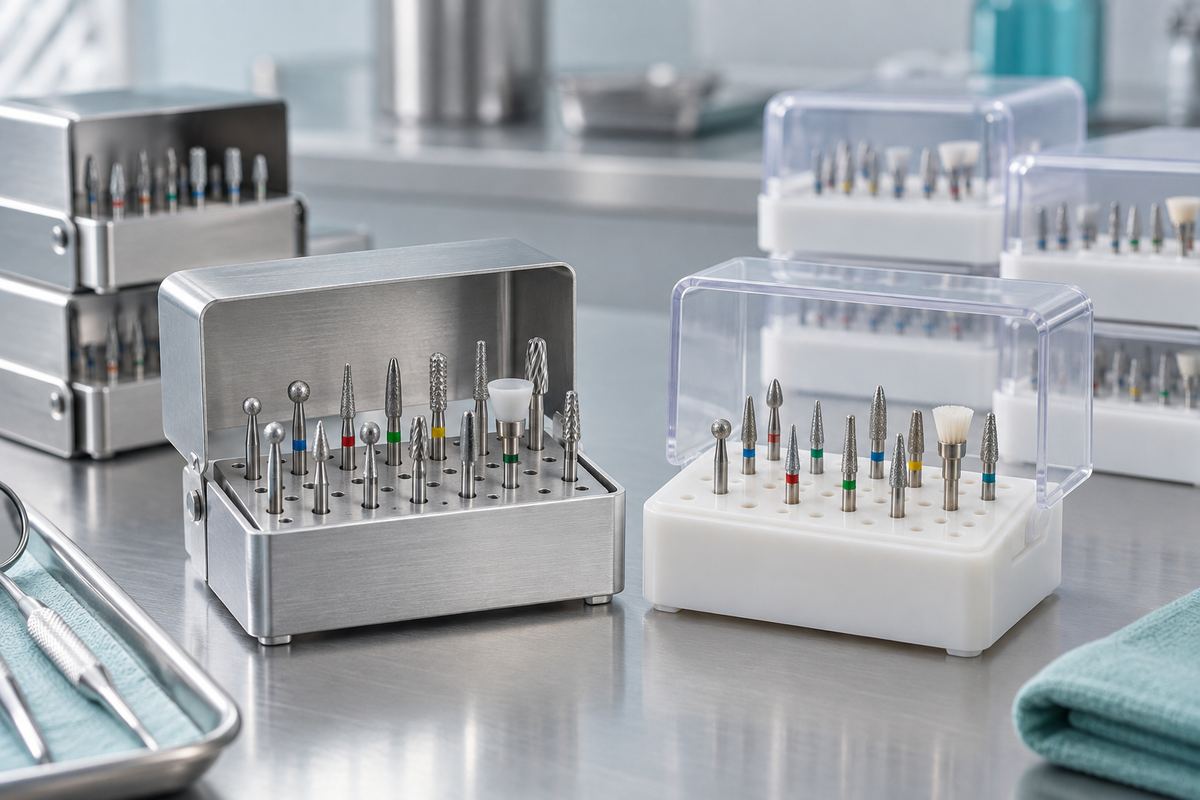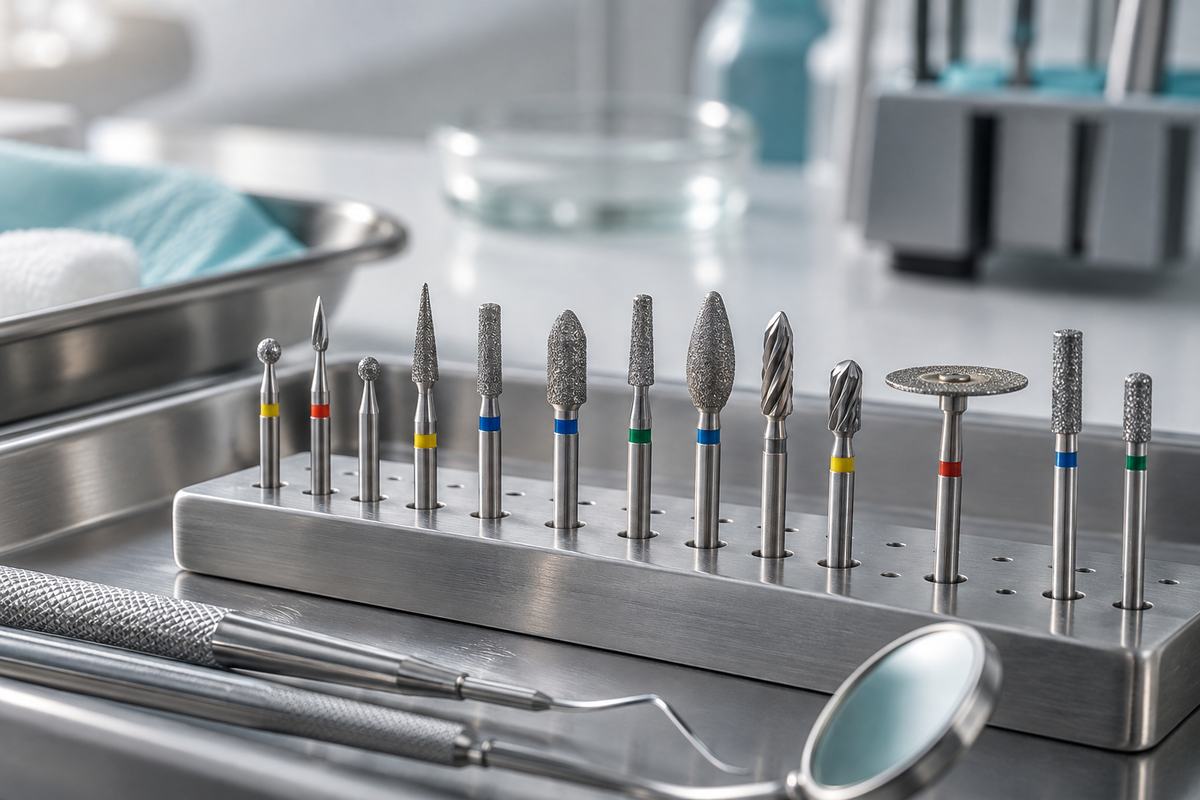
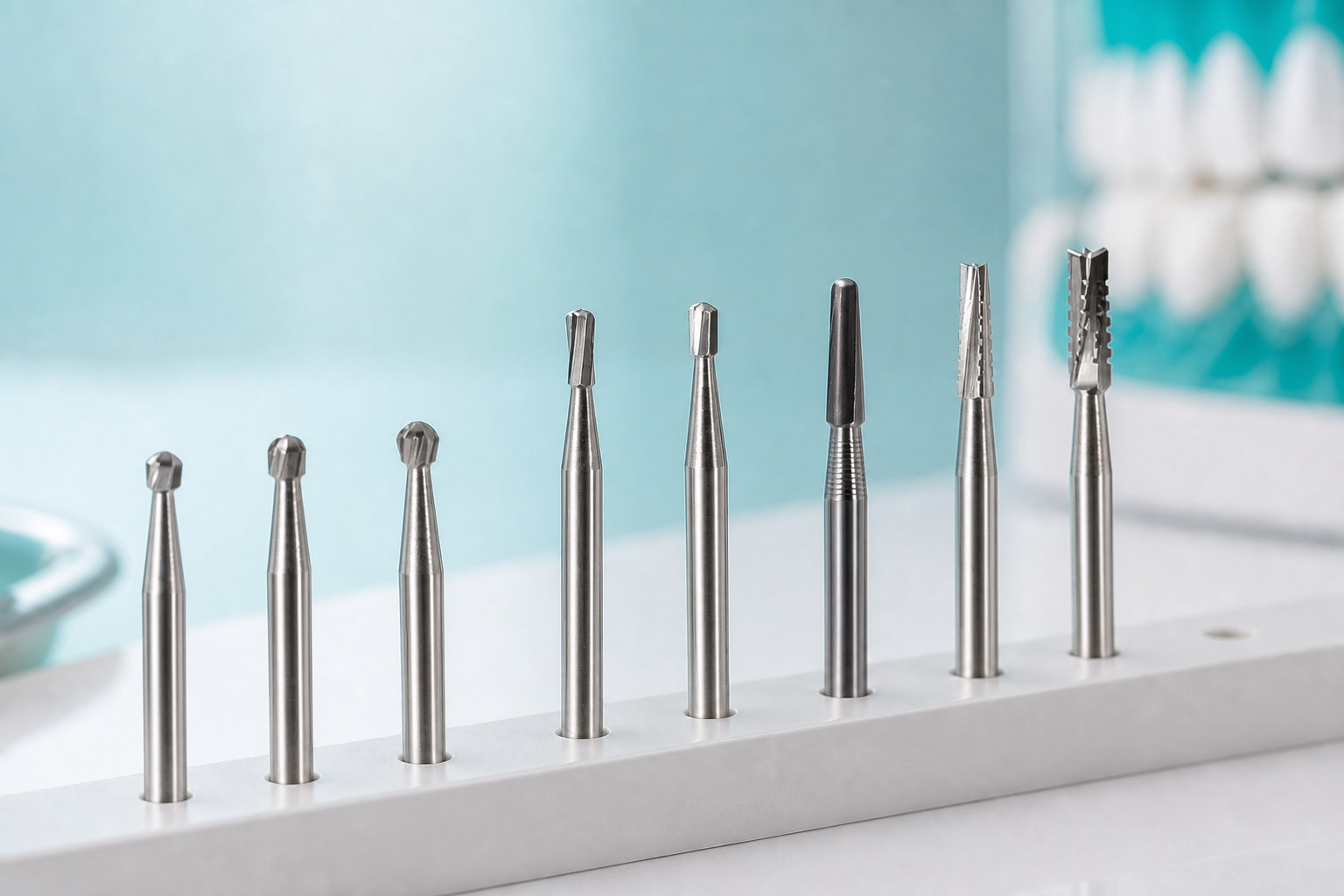
FG carbide burs are the friction-grip tungsten carbide instruments that run in a high-speed handpiece: caries removal, access openings, crown sectioning, amalgam removal and composite finishing all rely on them. They cut with blades rather than abrasive grit, shearing material off instead of grinding it away, and that single difference decides where carbide beats diamond and where it does not.
This guide covers what the FG designation actually controls, the head shapes worth keeping in stock, how the size number on the packet is read, and where a diamond does the job better. It is written for the person placing the order: a clinic purchaser, a lab manager, a dealer building a catalogue.
What FG means on a carbide bur
FG stands for friction grip. The shank is 1.6 mm in diameter and is held in the chuck of a high-speed turbine or an electric contra-angle. The other two shank codes in the same catalogue are RA, the 2.35 mm latch-type shank for slow-speed contra-angles, and HP, the 2.35 mm straight shank for laboratory handpieces. The same head shape is often offered on all three, so the shank code, not the shape, is what tells you the bur will seat in your handpiece.
Shank length is the second half of the specification. Standard-length FG covers routine restorative work. Short-shank FG helps in second molars and in patients with limited opening. Surgical-length FG reaches deep for sectioning and bone removal. Order by shank type and length together, because head shape and size alone do not identify a SKU. Our FG carbide burs are listed the same way, for the same reason.
The head shapes worth stocking
Most practices run on six or seven shapes. The rest are variations aimed at a particular technique or a particular operator's habit.
| Head shape | Where it earns its place | What the buyer should note |
|---|---|---|
| Round | Access openings, caries excavation, retention grooves | Stock several sizes; the smallest heads wear out fastest |
| Pear | Conservative occlusal preparations | Rounded end keeps internal line angles soft |
| Straight fissure | Flat cavity floors, box forms | Plain-cut version leaves the smoothest wall |
| Crosscut fissure | Sectioning teeth, cutting old crowns off | Cuts faster and leaves a rougher surface |
| Tapered fissure | Crown and bridge preparation walls | The taper sets the convergence angle |
| Inverted cone | Undercuts and amalgam retention | Cuts on the side and on the flat top |
| Multi-blade finishing | Composite contouring, margin refinement | More blades, smoother finish, slower removal |
| Surgical length | Deep sectioning, third molar work | Longer shank; check handpiece clearance |
Finishing burs deserve their own line on the order sheet. They are the same carbide cut with many more blades, and they are consumed faster because operators keep using them after the edges dull. Practices that finish a lot of composite usually buy trimming and finishing carbide burs in larger quantities than their cutting burs.
How the size number is read
The three-digit number quoted next to the shape, such as 008, 010, 012 or 014, is the head diameter in tenths of a millimetre. A 012 head measures 1.2 mm across; an 016 measures 1.6 mm. Diamonds use the same convention, which is why a purchaser can hold an old packet against a new supplier's list and compare like with like. Under the ISO 6360 numbering system the full code also encodes material, shank type, shank length, head shape and working surface, but in day-to-day ordering the shape name plus the size number carries the conversation.
Blade count is the other number on the packet. Cutting burs carry a small set of deep, widely spaced blades so chips clear and the head does not pack with dentine. Finishing burs carry many more, with 12-blade, 16-blade and 30-blade versions as the common steps, and each step up leaves a smoother surface while removing less material per pass. A 30-blade finisher is a refining instrument. Using it to reduce bulk heats the restoration and dulls the bur.
Carbide or diamond for the step
Carbide shears, diamond grinds. That is the whole basis for choosing between them.
Carbide holds the advantage on anything that responds to a blade: composite finishing where the margin should be defined rather than scratched, amalgam removal, sectioning old crowns and bridges, trimming acrylic and denture bases, and cutting through metal copings. The cut surface comes out smoother and the instrument runs with less vibration at the same speed.
Diamond holds the advantage on hard, brittle material: enamel reduction for crown preparation, porcelain and lithium disilicate adjustment, and anything zirconia. Carbide blades round off quickly against sintered ceramic, so a crown-and-bridge tray usually carries diamond burs for the reduction and carbide for the finishing and removal work. Most operatories stock both and switch mid-procedure rather than forcing one bur through the whole case.
Handling, sterilization and replacement
Tungsten carbide tolerates autoclaving. What damages a carbide bur between patients is chemistry and handling rather than heat: chloride-based disinfectants pit the steel shank, mixed metals sitting together in an ultrasonic bath set up corrosion, and wet storage after the cycle marks the blades. Clear debris off before processing, dry the burs, and keep them in a sterilisable bur block instead of loose in a drawer.
Replace on performance, not on a calendar. A bur that needs pressure to cut is producing heat instead of chips, and heat is what damages pulp and composite margins. Where local rules or the manufacturer's labelling designate a bur single-use, that designation stands regardless of how the bur looks after one case.
Buying FG carbide burs wholesale
BurDental has manufactured rotary dental instruments since 2008 and sells direct from the factory to clinics, laboratories and dealers, with no distributor layer between the production line and the invoice. Products are CE marked and made in an ISO 13485 factory.
Three questions come up before almost every first order.
- Samples. Tell us the shapes and sizes you want to test and we will arrange a sample set, so your operators can judge the cut before you commit to a volume order.
- Private label. We run OEM and private-label production with your branding on the packet and the packaging inserts.
- Minimums. They are low, and a first order can mix shapes and sizes across the range. Send your list and we will quote it.
The wider range sits on the dental burs wholesale hub, and the fastest channel for a quote is WhatsApp at +86 186 8057 1046.
Frequently asked questions
What does FG mean on a dental bur?
FG means friction grip: a 1.6 mm shank that the chuck of a high-speed turbine or an electric contra-angle grips directly. RA burs use a 2.35 mm latch-type shank for slow-speed contra-angles, and HP burs use a 2.35 mm straight shank for laboratory handpieces.
Are FG carbide burs better than diamond burs?
Neither is better across the board; they fail in different places. Carbide cuts cleaner on composite, amalgam, metal and acrylic, while diamond outlasts carbide on enamel, porcelain and zirconia. Trays that carry both and switch between them get the most out of each.
Can FG carbide burs be autoclaved and reused?
Tungsten carbide withstands standard autoclave cycles, so carbide burs are commonly reprocessed where the manufacturer's labelling and local infection-control rules allow it. Burs labelled single-use stay single-use, and any bur that has lost its edge should be replaced rather than reprocessed.
How do I know which size to order?
Read the size number as head diameter in tenths of a millimetre: 010 is 1.0 mm and 014 is 1.4 mm. Match the shape name and size number against your current packets, then confirm the shank code and shank length before the order goes out.
Do you sell FG carbide burs wholesale or under our own brand?
Both. BurDental sells factory-direct at wholesale to clinics, laboratories and dealers, and produces private-label and OEM runs with your branding on the packaging. Minimums are low; send your list and we will quote.