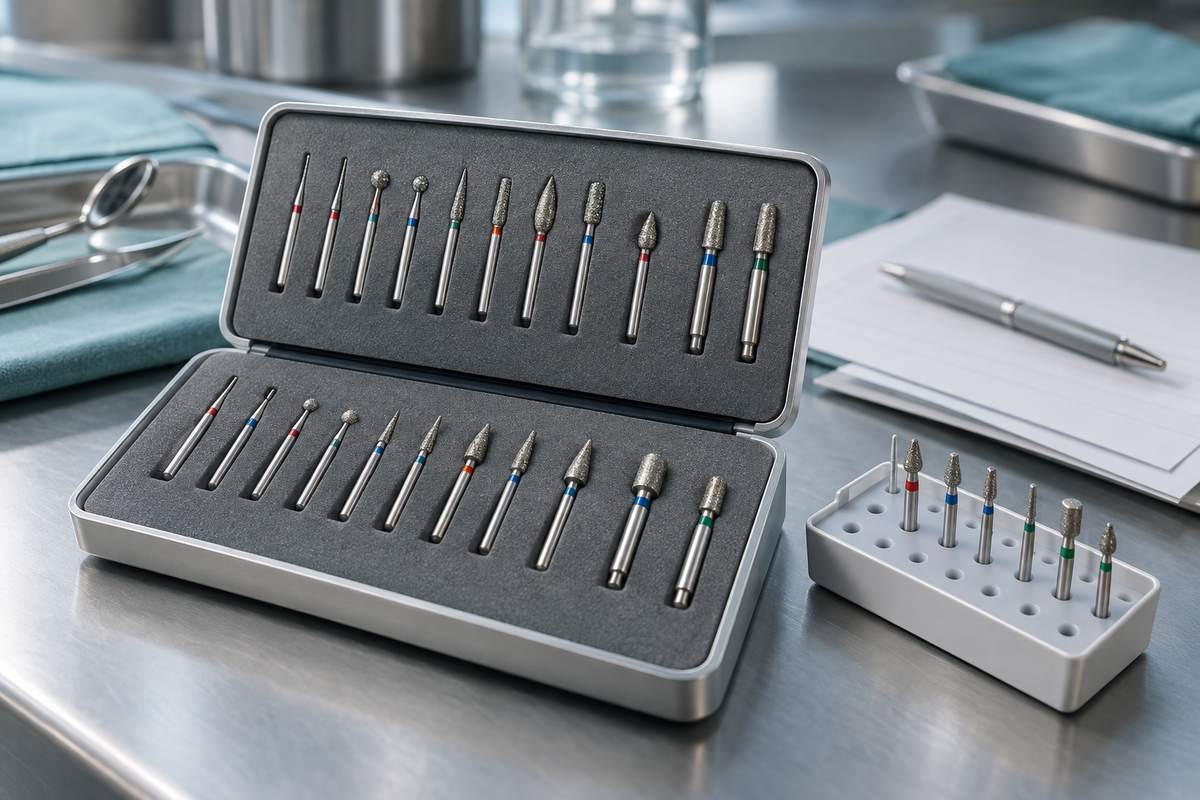
Procuring rotary instruments in bulk involves substantial financial and operational commitments for dental clinics, dental laboratories, and regional distributors. Selecting substandard rotary cutting tools leads to premature head wear, handpiece turbine damage from eccentric shanks, poor clinical finishing, and patient dissatisfaction. Establishing a systematic evaluation framework helps buyers identify dependable dental burs suppliers who deliver consistent quality, competitive factory pricing, and stable delivery timelines.
This guide outlines the complete procurement process for evaluating potential manufacturing partners. By following a structured vetting sequence covering factory audits, regulatory certification checks, pre-production sample testing, and controlled trial orders, purchasers can eliminate supply chain uncertainty before signing large commercial agreements.
Step 1: Differentiating Direct Manufacturers from Trading Companies
The first stage in supplier evaluation is verifying whether the vendor operates an actual production plant or functions as a third-party intermediary. Trading companies frequently advertise factory-direct pricing while outsourcing production to third-party workshops with varying quality controls. Dealing directly with a genuine manufacturer provides greater control over batch consistency, technical modifications, custom packaging, and volume pricing.
Direct manufacturers maintain dedicated Computer Numerical Control (CNC) Swiss-type automatic lathes, centerless grinding machinery, multi-stage electroplating lines, and automated optical inspection systems. When screening potential vendors, request documentation that confirms factory ownership:
- Production line evidence: Request live video walkthroughs or dated recordings showing active CNC turning equipment, diamond electroplating tanks, and automated brazing stations for carbide heads.
- Custom manufacturing capabilities: Inquire about OEM laser marking, private label blister packaging, and custom grit bonding options. Direct manufacturers handle these specifications in-house without third-party markup.
- Technical responsiveness: Engage with the supplier's engineering team regarding shank hardness, ISO dimensional tolerances, and coating adhesion. Factory representatives provide specific technical data rather than generic sales brochures.
BurDental was founded in 2008 as a direct manufacturer of dental rotary instruments, operating an ISO 13485 factory with full in-house production control across clinical and laboratory product lines.
Step 2: Auditing Medical Device Certifications and Regulatory Compliance
Dental rotary cutting instruments are classified as medical devices and must satisfy stringent regulatory and quality management benchmarks. Verifying the validity and scope of a supplier's compliance documentation prevents customs clearance delays and ensures patient safety across clinical environments.
When auditing supplier credentials, verify two primary regulatory benchmarks:
- ISO 13485 Certification: This standard defines quality management system requirements specifically for medical device manufacturing. Confirm that the certificate scope explicitly lists dental rotary instruments, dental burs, diamond polishers, or laboratory cutters. Verify that the legal company name on the certificate matches the invoicing entity and shipping documentation.
- CE Marking: A valid CE mark demonstrates conformity with European medical device directives and regulations. Request the official Declaration of Conformity and the associated Notified Body certificate. Check the expiration dates and confirm that the certificate remains in good standing on public regulatory databases.
Suppliers unable or unwilling to share verifiable certification numbers or third-party audit summaries should be excluded from procurement shortlists.
Step 3: Procuring and Benchmarking Physical Samples
Never commit to a full container or high-volume wholesale order based solely on digital product catalogs. Physical sample testing provides objective proof of machining accuracy, material purity, and cutting endurance under clinical conditions.
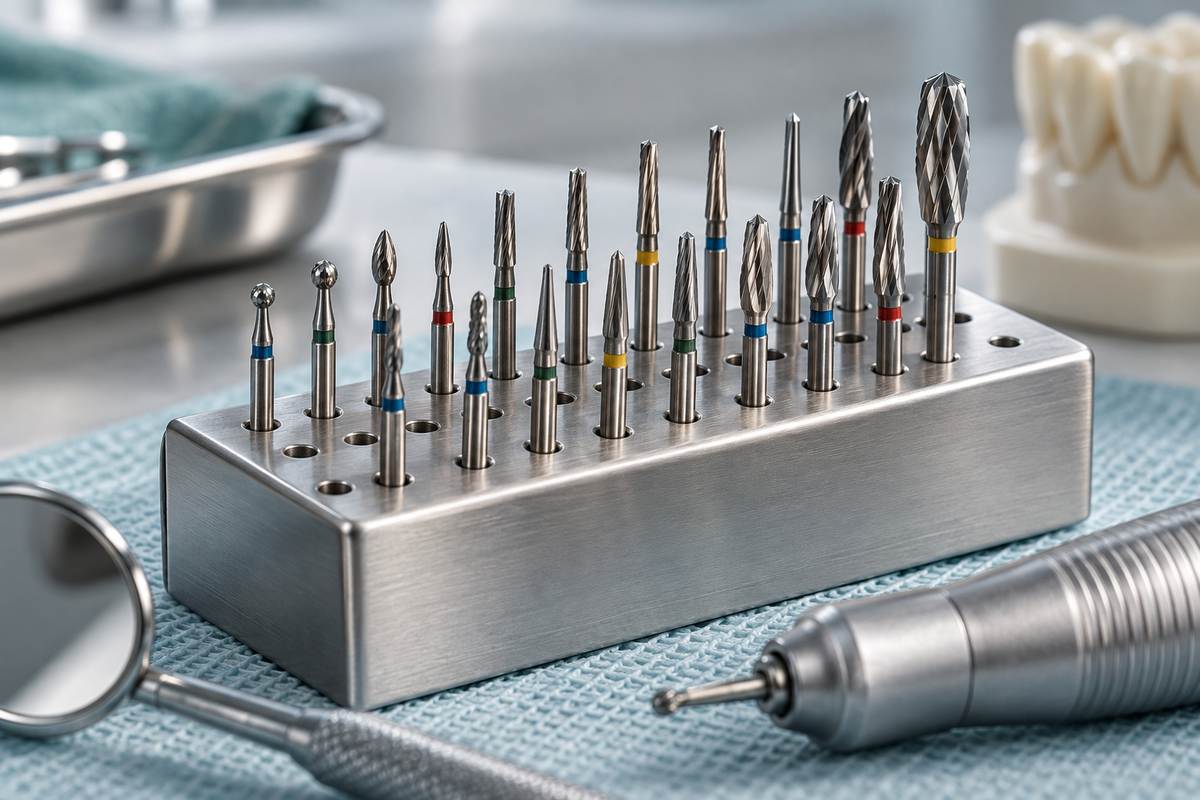
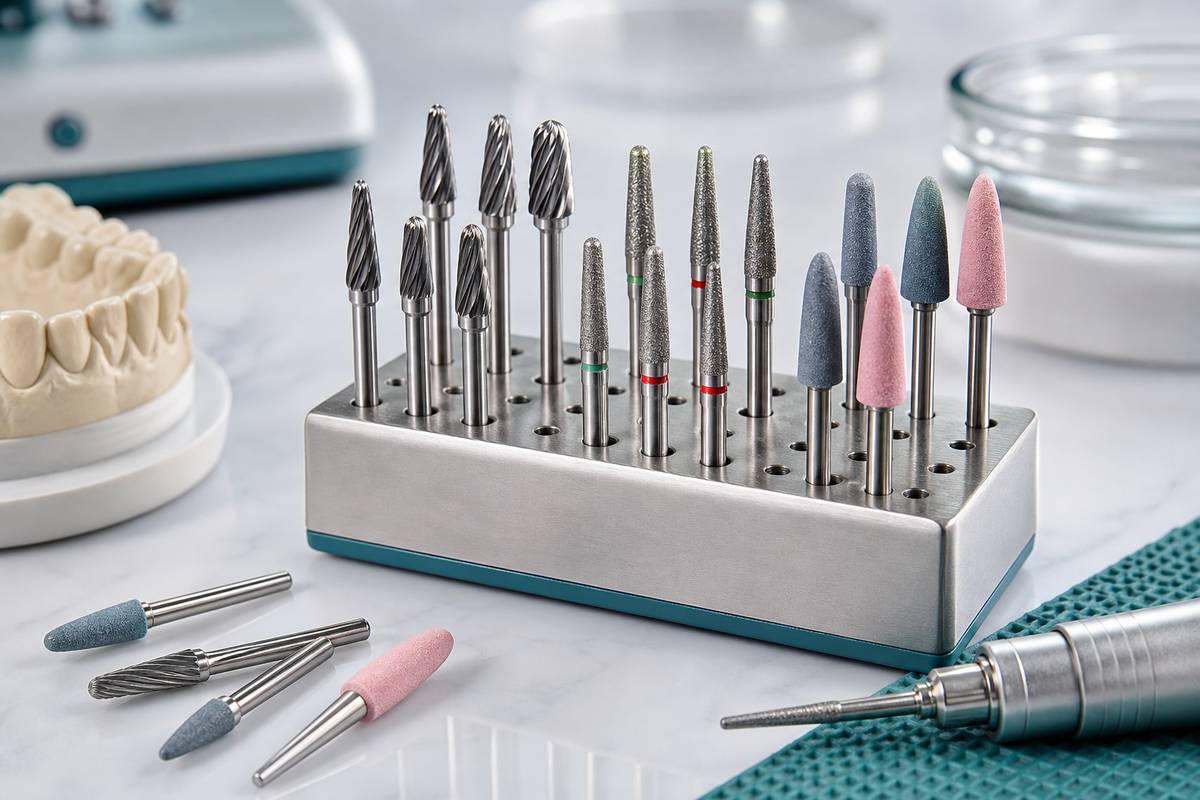
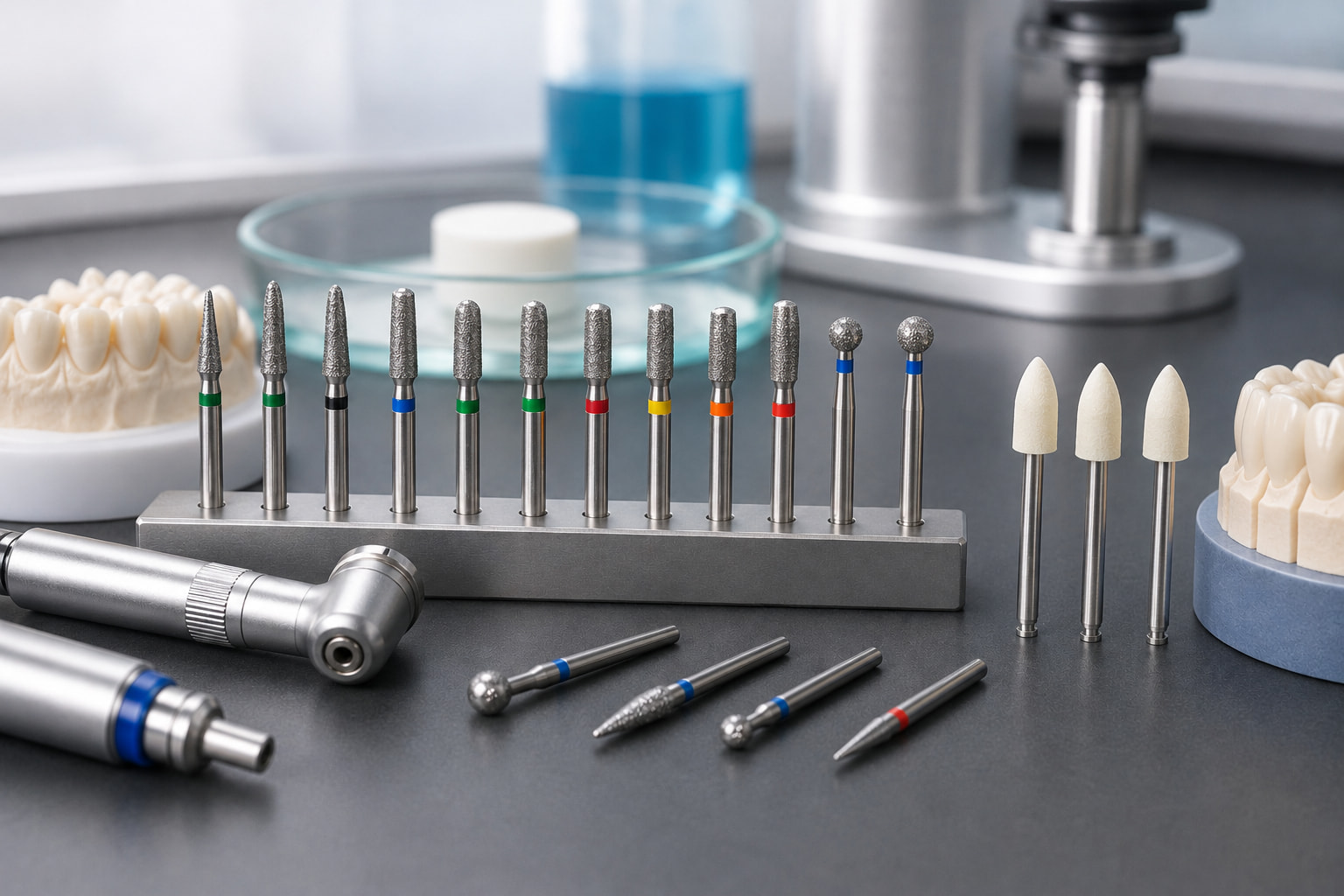
Reputable manufacturers offer structured sample collections to simplify multi-item testing. Buyers can evaluate broad product lines using a dedicated Samples Collection / Burs Folder such as SKU 170B5, SKU 1701D, or SKU 1702T. For operatory testing, standard clinic assortments like Clinic Kits (SKU 4104 and SKU 4105) provide practical sets for immediate chairside evaluation.
Conduct physical testing across four critical quality parameters:
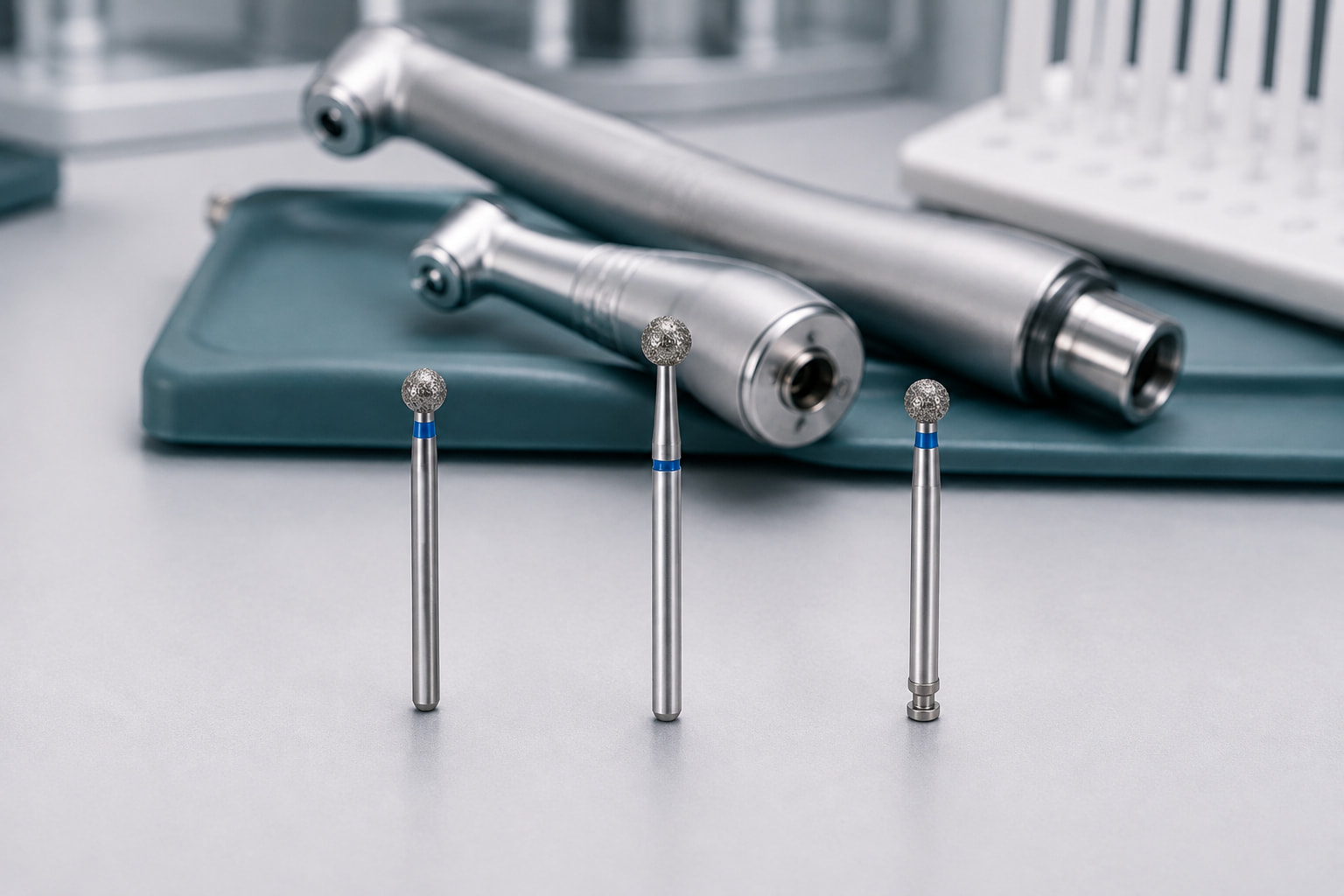
- Shank Diameter and Concentricity: Use a calibrated digital micrometer to measure shank outer diameter across friction grip (FG 1.60 mm), right angle latch (RA 2.35 mm), and handpiece (HP 2.35 mm) instruments. Mount sample Diamond Burs (such as SKU 001-008S, SKU 001-010M, or SKU 001-012M) into an air turbine or micromotor handpiece. Measure radial runout with a dial test indicator. Low concentricity creates excessive vibration, accelerates handpiece chuck wear, and causes irregular tooth preparation margins.
- Diamond Grit Uniformity and Bonding: Inspect the working head under an optical microscope at 30x to 50x magnification. Look for even diamond particle distribution without bald spots, excessive matrix pooling, or irregular particle clumping. Test cutting efficiency on extracted teeth or composite blocks to verify that diamond crystals do not dislodge prematurely during initial contact.
- Carbide Flute Geometry and Weld Integrity: For carbide burs and cutters, inspect the braze joint between the tungsten carbide head and stainless steel shank. The joint must exhibit no voids, microcracks, or flux contamination. Spin the bur through hard acrylic or metal coping material to evaluate blade sharpness and chatter resistance.
- Autoclave and Corrosion Resistance: Place test burs into a Bur Block Sterilisable Alluminum/Plastic (such as SKU BB201 or SKU BB202) and run them through repeated steam autoclave cycles at 134 degrees Celsius. Inspect for shank rust, discoloration, matrix pitting, or adhesive breakdown. High-grade stainless steel shanks resist oxidation throughout repeated clinical reprocessing cycles.
Supplier Evaluation Framework Matrix
Use the following evaluation matrix to score prospective vendors during the onboarding process.
| Procurement Stage | Assessment Focus | Verification Standard | Target Evidence & Tooling |
|---|---|---|---|
| Facility Audit | Manufacturing directness | Direct production facility vs export trader | Live CNC line review; Dental Burs Wholesale hub |
| Regulatory Check | Quality management standards | ISO 13485 factory standard and CE marked compliance | Official registration certificates and audit reports |
| Dimensional Check | Shank tolerance and runout | Precision shank diameter with minimal dynamic vibration | Calibrated micrometer and dial runout gauge |
| Sample Evaluation | Diamond bonding and grit distribution | Uniform particle coating without early diamond loss | Diamond Burs (001-008S, 001-010M, 001-012M) |
| Catalog Sampling | Product range and packaging indexing | Organized bur folder presentation and reference indexing | Samples Collection / Burs Folder (170B5, 1701D) |
| Reprocessing Test | Thermal and chemical stability | Resistance to oxidation across steam autoclave cycles | Bur Block Sterilisable Alluminum/Plastic (BB201, BB202) |
| Commercial Terms | Logistics and order flexibility | Low minimums, clear lead times, free shipping over $300 | Clinic Kits (4104, 4105) trial order |
Step 4: Structuring a Controlled Trial Order
Once physical samples meet technical requirements, initiate a small-scale trial order before committing to volume purchase contracts. A trial order tests the supplier's commercial fulfillment capabilities under real operating conditions.
Key checkpoints during the trial order phase include:
- Order processing speed: Track how quickly the vendor generates formal proforma invoices, confirms SKU availability, and provides production schedules.
- Packaging quality: Inspect the final export cartons, inner plastic boxes, blister packs, and barcode labeling upon arrival. Packaging must protect delicate rotary heads from impact damage during international transit.
- Commercial terms and logistics: BurDental supports low minimums for evaluation orders and provides free shipping on qualifying orders over $300. Clarify shipping incoterms, customs documentation, and tracking support prior to payment dispatch.
- Direct communication channel: Reliable suppliers maintain accessible customer service channels. Factory inquiries can be coordinated directly via WhatsApp at +86 186 8057 1046 for rapid shipment tracking and technical support.
Step 5: Establishing Long-Term Quality Control Agreements
Following a successful trial order, formalize long-term purchase agreements that protect pricing stability and quality consistency. Establish clear acceptable quality limit (AQL) standards for incoming shipments, specifying defect thresholds for shank runout, packaging errors, and surface finish.
schedule periodic batch re-testing to ensure that mass production lots maintain the exact tolerances verified during the initial sample phase. Long-term supplier partnerships built on transparent factory auditing and systematic quality control deliver dependable clinical tools while reducing overall consumable procurement costs.
Frequently asked questions
How can a dental buyer verify if an overseas supplier is a true manufacturer?
Buyers should request official ISO 13485 audit reports, business licenses displaying manufacturing scope, and live video facility walkthroughs of CNC turning and electroplating workshops. True manufacturers accommodate custom shank dimensions, custom diamond grit combinations, and private label packaging directly from the factory floor.
What quality certifications are required when importing dental burs?
Wholesale dental rotary instruments require an ISO 13485 certified quality management system and valid CE marking for medical device regulatory compliance. BurDental manufactures all rotary instruments in an ISO 13485 factory established in 2008 with CE compliance.
What is the typical minimum order quantity for wholesale dental bur trial orders?
BurDental offers low minimums on trial orders to enable clinics, laboratories, and dealers to evaluate instrument performance before scaling to high-volume contracts. Prospective buyers can contact the factory directly for specific SKU trial order minimums and wholesale tier quotes.
What shipping policies apply to wholesale dental bur orders?
BurDental provides free shipping on wholesale orders exceeding $300. Orders are packed in protective export cartons and dispatched with full international tracking.