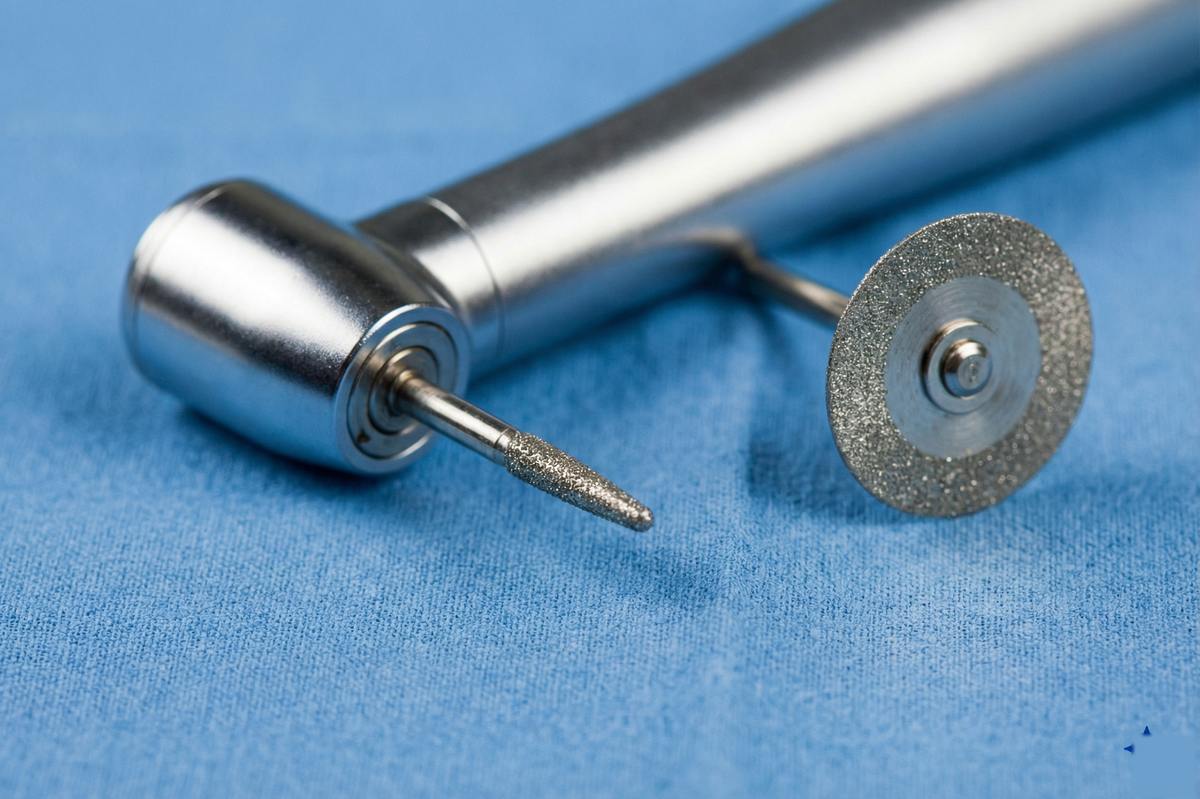
Diamond discs and diamond burs both use diamond abrasive to cut tooth structure and restorative materials. But they cut differently, access different areas, and serve different clinical purposes. Choosing the wrong one doesn't just slow you down — it can damage adjacent teeth or leave a subpar finish.
Here's how to decide which tool to reach for.
How They Cut: Rotary Point vs Flat Disc
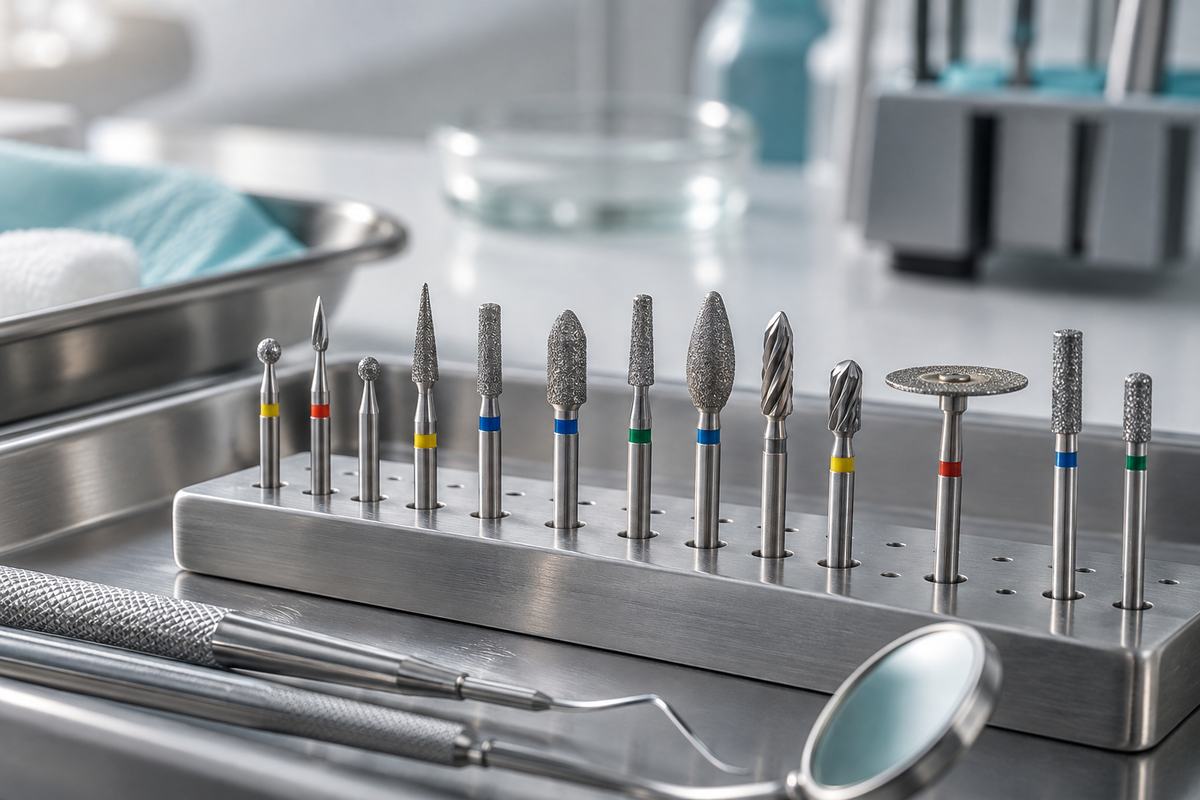
A diamond bur is a rotary point — a small metal blank coated with diamond grit, spinning at 200,000-400,000 RPM in a high-speed handpiece. It cuts in all directions the head contacts the surface, making it versatile for contouring, reducing, and shaping three-dimensional surfaces like crowns, cavities, and occlusal anatomy.
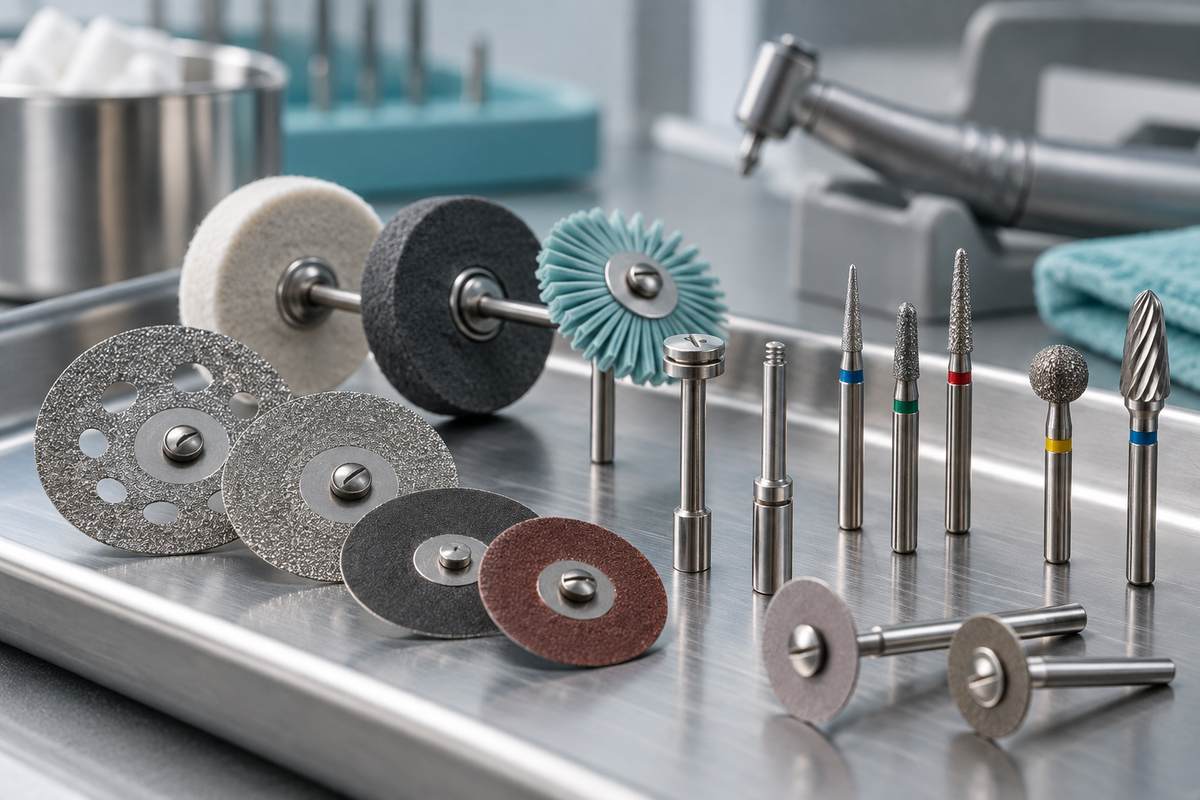
A diamond disc is flat. It spins in a single plane and cuts only along its edge. Think of it as a miniature circular saw with diamond-coated rim. This makes it precise for straight-line cuts — interproximal reduction, sectioning crowns, slicing through ceramics — but nearly useless for contouring or shaping curved surfaces.
| Feature | Diamond Bur | Diamond Disc |
|---|---|---|
| Cutting Action | Multi-directional (point contact) | Single-plane (edge contact) |
| Speed | 200,000–400,000 RPM (high-speed) | 10,000–30,000 RPM (slow-speed/lab) |
| Best For | Crown prep, cavity prep, contouring | IPR, sectioning, flat cuts, trimming |
| Access | Reaches deep, narrow areas | Needs open access, straight-line path |
| Adjacent Tooth Risk | Higher — tip contacts where aimed | Lower — controlled flat cut plane |
| Handpiece | FG high-speed or RA slow-speed | RA mandrel in slow-speed |
When to Use a Diamond Bur
Diamond burs are the workhorse of clinical dentistry. Reach for them when you need to:
- Prepare crowns and veneers — tapered burs (856, 847) create the axial reduction and margin definition that discs simply can't achieve on curved tooth anatomy.
- Remove old ceramic restorations — a coarse round-end taper cuts through porcelain-fused-to-metal crowns faster than any disc, and you can control depth precisely.
- Adjust occlusion on ceramics — football-shaped diamond burs (368) contour occlusal surfaces after cementation. A disc would flatten anatomy instead of preserving it.
- Refine subgingival margins — flame burs (862) reach below the gumline where no disc can follow.
- Enameloplasty and tooth reshaping — fine-grit diamonds smooth and reshape labial surfaces with control a disc can't match on convex surfaces.
For a deeper look at diamond vs carbide selection, see our diamond burs vs carbide burs comparison.
When to Use a Diamond Disc
Diamond discs excel where burs struggle — anywhere you need a thin, straight, controlled cut:
- Interproximal reduction (IPR) — diamond finishing strips handle light IPR, but when you need to remove 0.3-0.5mm from mesial or distal surfaces, a thin diamond disc does it cleanly without rounding the contact.
- Sectioning failed crowns — cutting a PFM crown in half for removal is a disc job. A bur would require multiple passes and risk the prep underneath.
- Trimming ceramic restorations in the lab — lab technicians use diamond discs daily to section sprues, trim margins on zirconia copings, and adjust proximal contacts on pressed ceramics.
- Cutting metal frameworks — removing a cast metal post or sectioning a metal-ceramic bridge is faster and more controlled with a diamond disc than a bur.
- Separating teeth for extraction — in surgical cases, a diamond disc can section a multi-rooted tooth along the furcation with less bone removal than a bur approach.
Diamond Disc Types
Not all diamond discs are the same. They vary by thickness, flexibility, and whether they cut on one side or both:
Rigid Diamond Discs
Metal core with diamond on the rim. These are stiff, aggressive, and meant for lab work — cutting metal, trimming zirconia, sectioning. Typical diameter: 22mm. They mount on a mandrel in a straight handpiece or lab motor.
Flexible Diamond Discs
Thinner, bendable discs for clinical use. They conform slightly to tooth surfaces and are less likely to gouge adjacent structures. Used for IPR, contouring composites, and finishing proximal surfaces.
Single-Sided (Safe-Side) Discs
Diamond coating on one face only. The uncoated side acts as a guard against damaging the adjacent tooth during interproximal work. If you're doing IPR between tight contacts, single-sided discs are non-negotiable.
Choosing the Right Tool: Decision Framework
Ask yourself three questions:
- Is the cut straight or curved? Straight → disc. Curved or three-dimensional → bur.
- Do I need to protect the adjacent tooth? If yes and the cut is interproximal → safe-side disc. If the access is tight or subgingival → use a thin bur with careful angulation.
- Am I cutting through metal? Sectioning metal restorations → disc (faster, less heat). Adjusting metal occlusion → bur.
Material Compatibility
Both diamond burs and diamond discs cut the same materials — enamel, ceramic, porcelain, zirconia, composite, and metal alloys. The difference is access and geometry, not material compatibility.
That said, for zirconia-specific work, coarse diamond burs designed for zirconia reduction outperform generic discs because they're engineered for the hardness and thermal sensitivity of high-translucency zirconia. Lab technicians working with zirconia frameworks still rely on diamond discs for flat cuts and sectioning, but shape-specific adjustments need a bur.
For composite finishing, the choice often comes down to surface geometry. Facial and lingual contours of a Class III or IV restoration? A fine-grit diamond bur in flame or round shape follows the curve. But the proximal surface — that flat contact area — is where a flexible finishing disc shines. Many clinicians use both on the same restoration: bur for the curved surfaces, disc for the flat proximal wall.
Maintenance and Lifespan
Diamond burs lose grit over time. On hard materials like zirconia, expect 3-5 uses before cutting efficiency drops noticeably. On enamel and composite, they last longer — 8-12 preparations isn't unusual for a quality bur. You'll feel the difference: a worn bur skips and chatters instead of cutting smoothly. Sterilize between patients with ultrasonic cleaning followed by autoclave.
Diamond discs wear differently. The rim wears thin, and on rigid discs, you can actually see the diamond layer disappearing. Flexible discs lose their edge faster, especially on metal. Most clinicians treat thin flexible discs as single-use — the cost is low and the risk of a worn disc grabbing tissue isn't worth saving a few cents.
Rigid lab discs last longer because they're thicker and used at lower speeds. A good rigid diamond disc can section dozens of metal frameworks before the diamond coating is spent. Clean them with an ultrasonic bath to remove embedded metal particles between uses.
Frequently Asked Questions
Can a diamond disc replace a diamond bur?
No, diamond discs and diamond burs serve different purposes. Diamond discs excel at making straight, flat, or slicing cuts such as interproximal reduction and crown sectioning. Diamond burs are needed for three-dimensional contouring tasks like cavity preparation and crown reduction, where a disc cannot access or shape curved surfaces.
What is a single-sided diamond disc used for?
A single-sided diamond disc has diamond coating on only one face, leaving the opposite side smooth and safe. This design protects adjacent teeth and soft tissue during interproximal procedures, making it the preferred choice for IPR and proximal surface finishing where only one side should cut.
Which is better for interproximal reduction: a disc or a bur?
A diamond disc is generally better for interproximal reduction (IPR). Discs produce a flatter, more uniform surface with easier thickness control, typically removing 0.1–0.5 mm per pass. Diamond burs can be used for IPR in tight spaces, but they are harder to control for even, predictable enamel removal between teeth.
How long do diamond discs last?
Diamond disc longevity depends on the type and usage. Flexible diamond discs are often single-use or last a few procedures before the diamond coating wears. Rigid sintered or bonded diamond discs can last through dozens of procedures with proper care. Disc performance drops noticeably once cutting slows, which signals it is time to replace.
Can you autoclave diamond discs?
Most reusable diamond discs can be autoclaved following the manufacturer's instructions, typically at 134°C for standard steam sterilization cycles. However, single-use discs and some flexible discs with adhesive-bonded diamond coatings may degrade during autoclaving. Always check the manufacturer's reprocessing guidelines before sterilizing.
The right tool depends on the cut you need, not the material you're cutting. Flat cut, tight contact, or sectioning? Grab the disc. Everything else? The bur handles it. Keep both in your setup and you won't be stuck reaching for the wrong one mid-procedure.