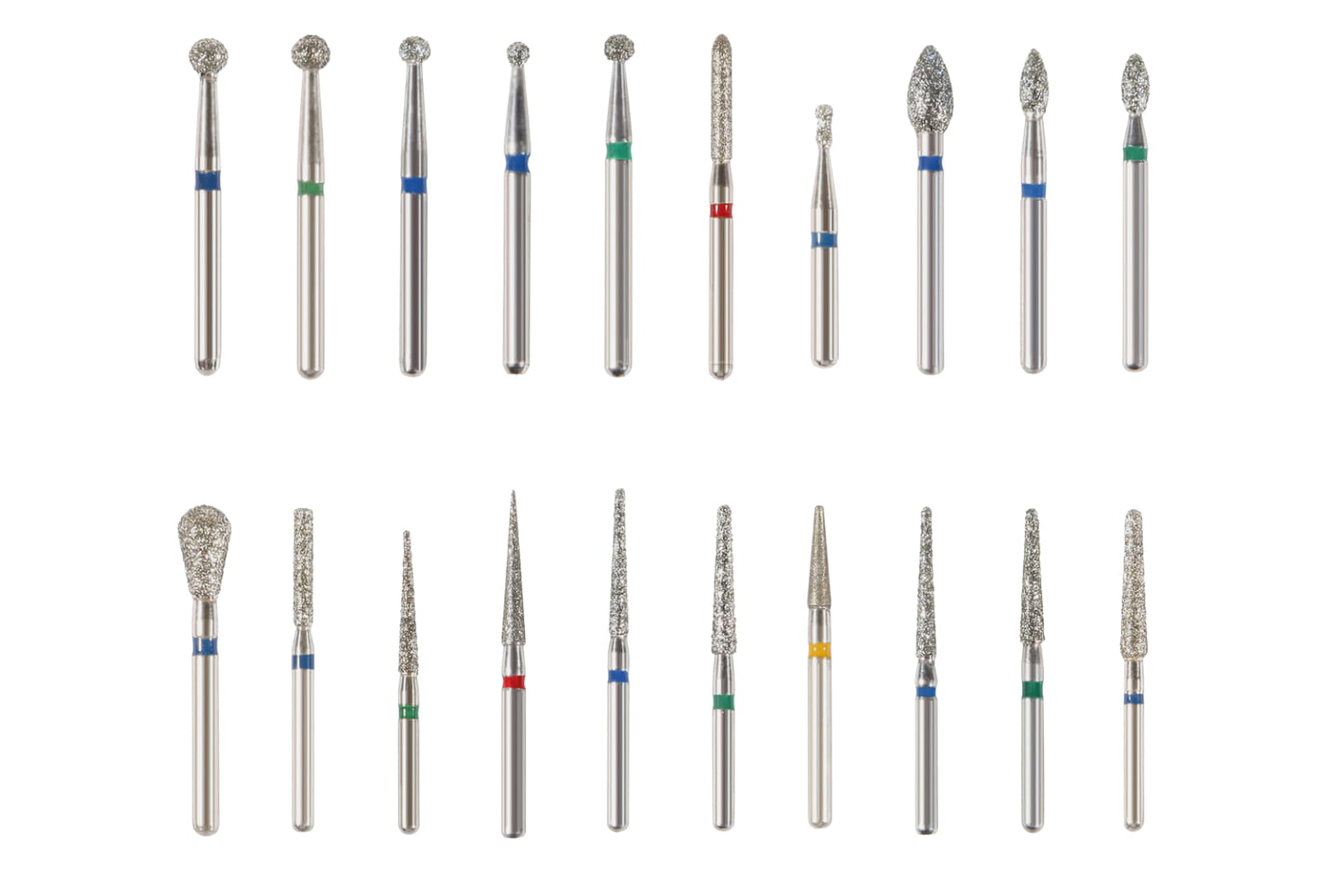
A dental bur chart is one of the most practical references a clinician or lab technician can keep nearby. With hundreds of shapes, sizes, grit levels, and ISO codes in circulation, having a clear guide saves time during instrument selection and ordering. This article breaks down every major bur category, the ISO numbering system, diamond grit color codes, shank dimensions, and common shapes used in everyday practice.
Types of Dental Burs
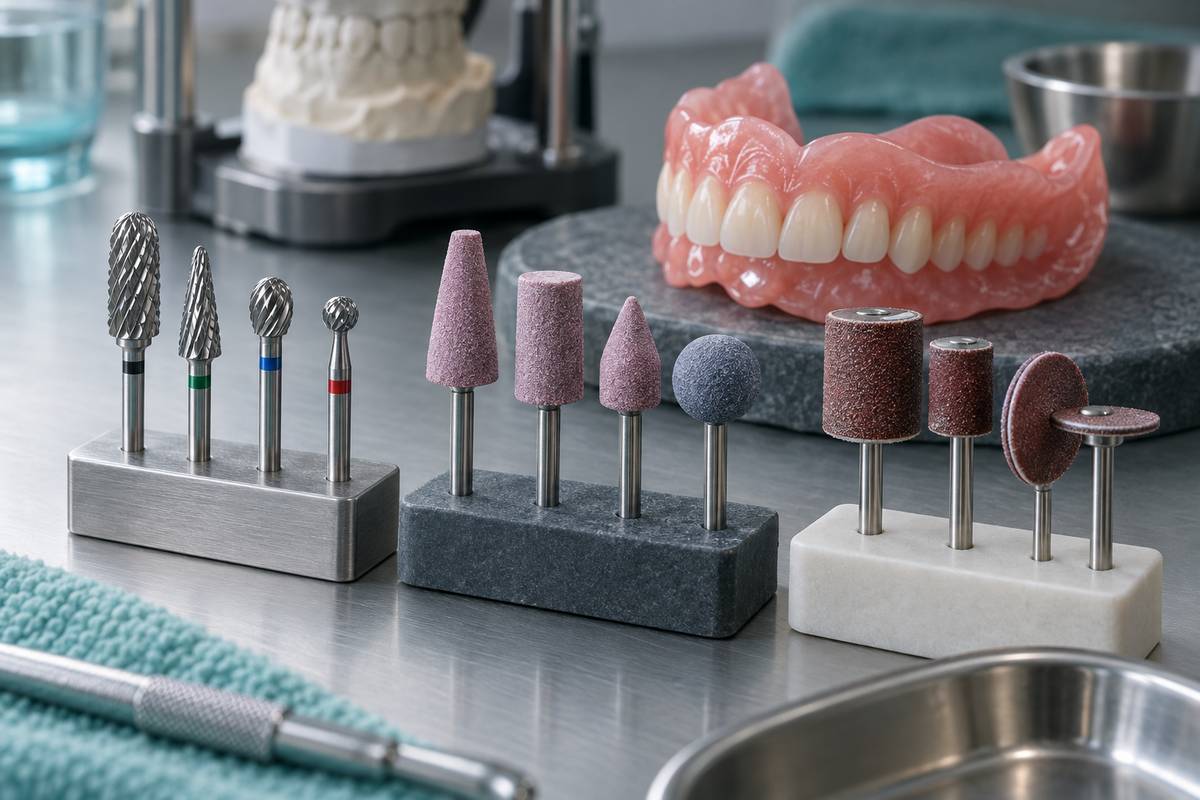
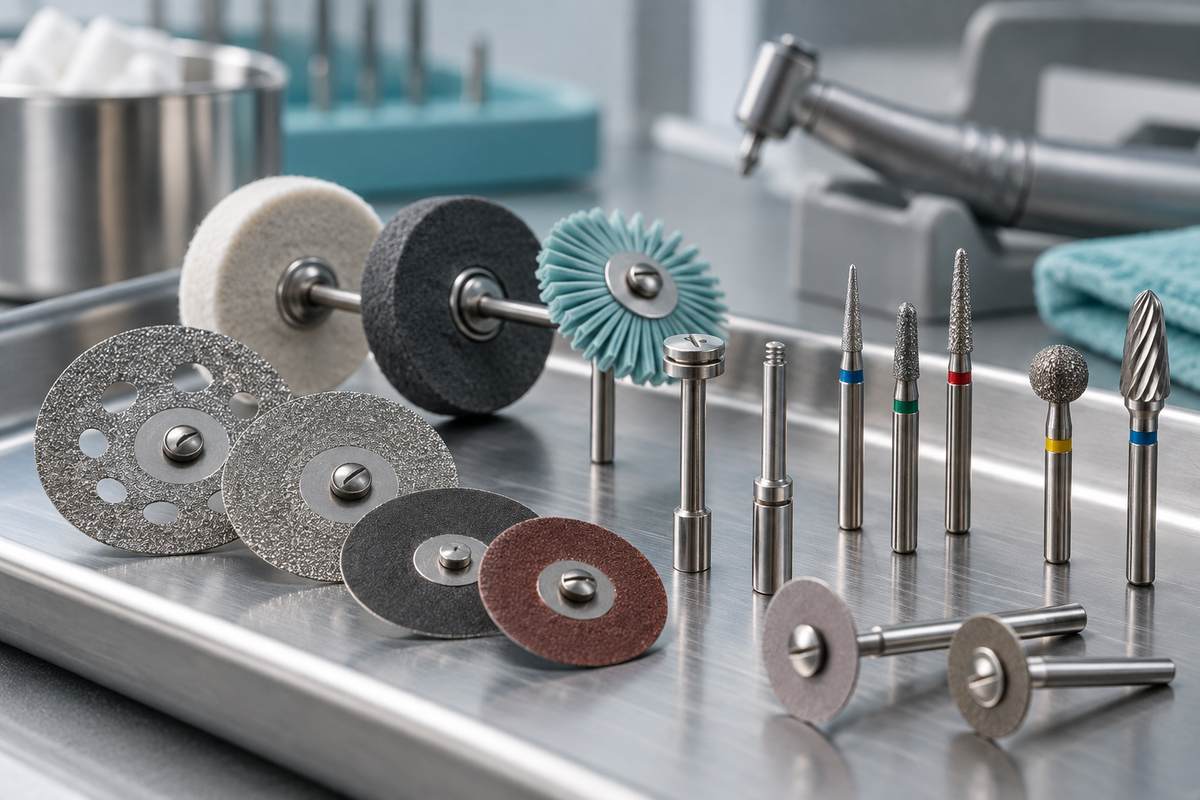
Dental burs fall into distinct categories based on their cutting material and mechanism. Each type serves specific clinical or laboratory functions, and understanding the differences is essential for efficient bur selection. Diamond burs (ISO 806) feature diamond particles bonded to a metal blank through electroplating or sintering. Electroplated diamond burs have a single layer of diamond grit attached with nickel, making them sharp initially but subject to gradual wear. Sintered diamond burs embed diamond particles throughout a metal matrix, offering longer life at the cost of slightly less aggressive cutting. Diamond burs work through abrasive grinding and are the standard choice for enamel reduction, ceramic adjustment, and crown preparation procedures. Nearly all clinical diamond burs use the FG (friction grip) shank. Tungsten carbide burs (ISO 500) are milled from solid carbide stock and cut through a blade-shearing action. The fluted blades produce smoother surfaces than diamond burs and generate less heat during cutting. Carbide burs are available in FG, RA (right angle), and HP (handpiece) shanks, making them versatile across clinical and laboratory applications. They excel at cavity preparation, amalgam removal, finishing composite restorations, and trimming acrylic in the lab. Steel burs are manufactured from stainless steel and share the ISO 500 classification with carbide burs. They cost less but dull faster, limiting their role in modern practice to low-speed caries excavation and occasional endodontic access. Most clinicians have replaced steel burs with carbide equivalents for better longevity and cutting performance. Mounted stones and rubber polishers round out the rotary instrument family. Mounted stones use aluminum oxide (Al₂O₃) or silicon carbide (SiC) abrasive bonded to an HP shank and are used for adjusting metal frameworks, porcelain, and denture bases. Rubber polishers incorporate abrasive particles in a silicone matrix and come in FG or RA shanks for intraoral polishing of composite and ceramic restorations.
Dental Bur Types Chart
Bur Type | ISO Code | Material | Cutting Action | Shank Types | Primary Use |
|---|---|---|---|---|---|
Diamond | 806 | Diamond-coated nickel/metal | Abrasive grinding | FG | Enamel, ceramics, crown prep |
Tungsten Carbide | 500 | Solid milled carbide | Blade shearing | FG, RA, HP | Cavity prep, finishing, lab trimming |
Steel | 500 | Stainless steel | Blade cutting | RA, HP | Caries removal (limited use) |
Mounted Stone | — | Al₂O₃ / SiC | Abrasive | HP | Adjusting, contouring, lab work |
Rubber Polisher | — | Silicone + abrasive | Polishing | FG, RA | Composite and ceramic polish |
Diamond Grit Sizes for Dental Burs
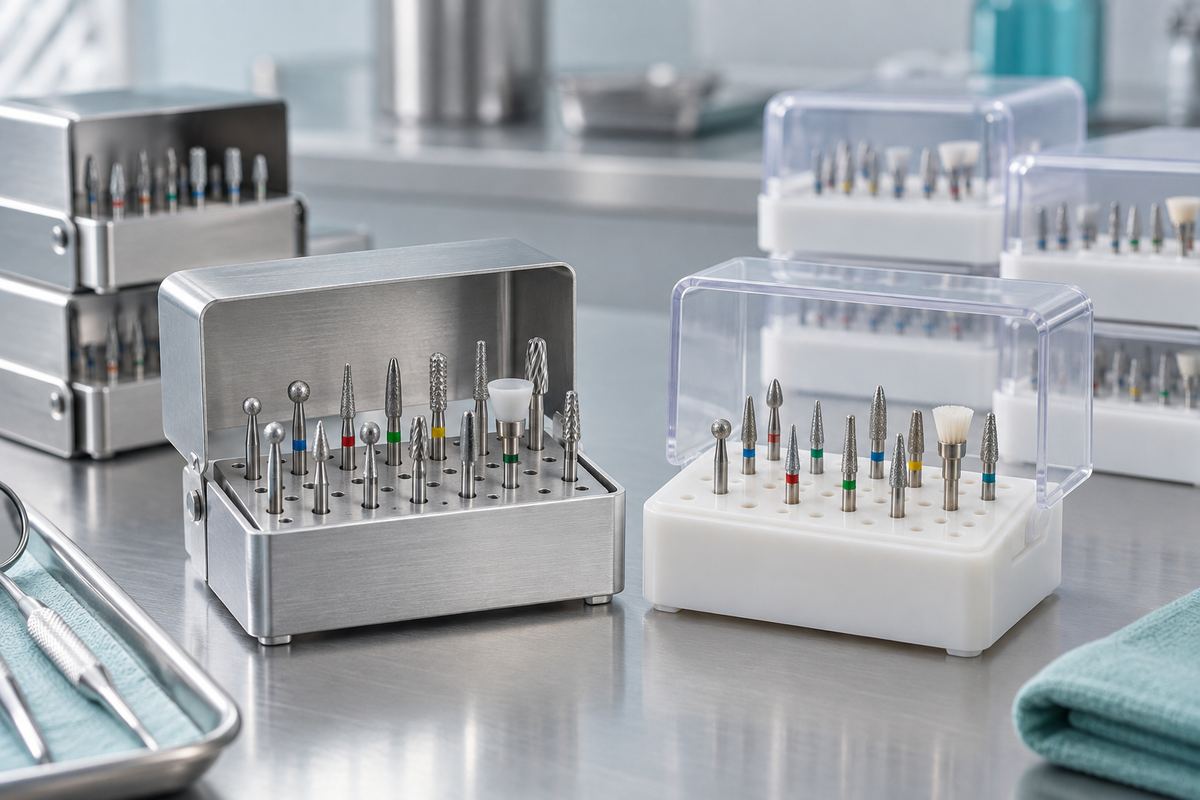
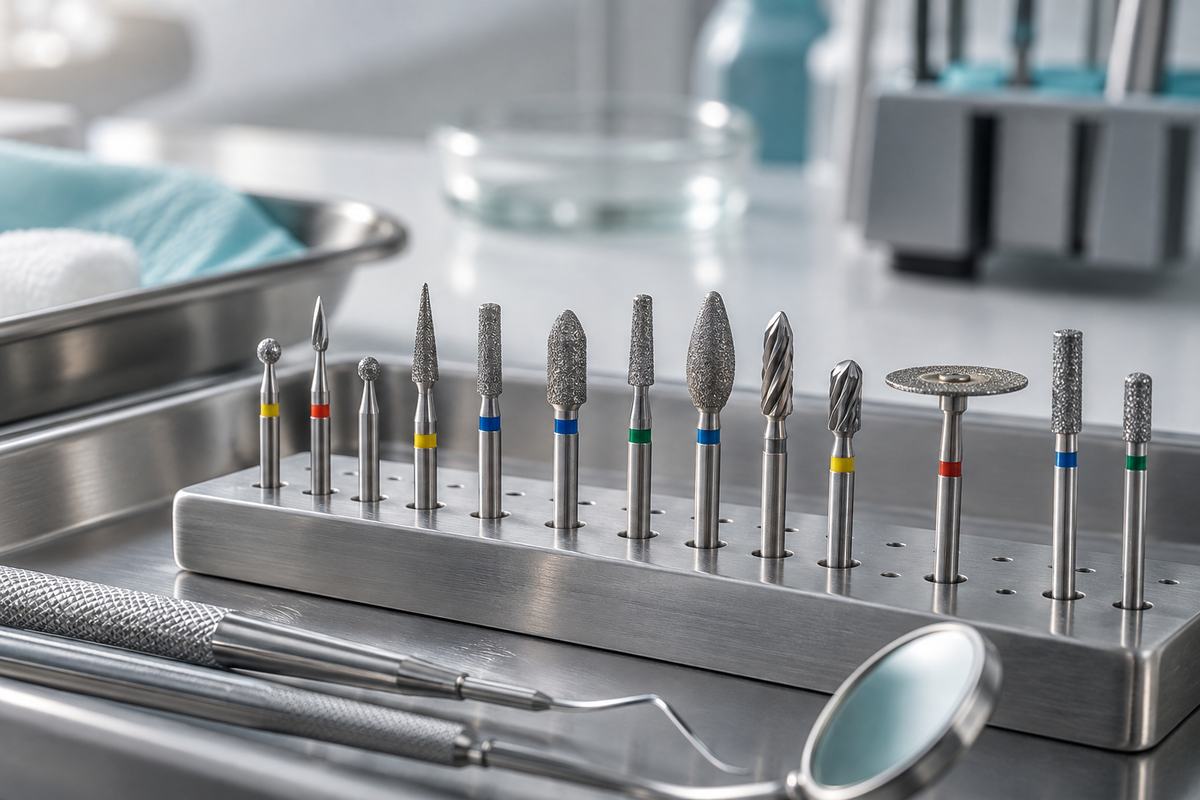
Diamond burs are manufactured in multiple grit levels, each designated by a color band on the shank according to ISO 7711-3. The grit size directly controls cutting aggressiveness, surface finish, and clinical application. Moving from coarse to fine grits follows the standard preparation-to-finish workflow most practitioners use daily. A typical crown preparation sequence starts with a green (coarse) or blue-band (medium) diamond bur for initial tooth reduction, then transitions to a red (fine) diamond for margin refinement, and finishes with a yellow (extra fine) for final smoothing before impression. Understanding this color system eliminates guesswork when selecting instruments from the dental bur color coding chart.
Diamond Bur Grit Size Chart (ISO 7711-3)
Color Band | Grit Designation | Particle Size (μm) | Application |
|---|---|---|---|
Black | Super Coarse | 180 | Rapid bulk reduction of enamel and old restorations |
Green | Coarse | 150 | Crown prep, enamel removal, aggressive shaping |
Blue (or no band) | Standard / Medium | 106 | General-purpose cutting, routine preparations |
Red | Fine | 46 | Finishing, margin refinement, contour adjustment |
Yellow | Extra Fine | 25 | Pre-polish smoothing, final margin finishing |
White | Ultra Fine | 15 | Super finishing, high-gloss surface preparation |
Black-band super coarse burs (180 μm) are rarely used in everyday clinical dentistry. They find application in aggressive bulk removal when speed is the priority, such as cutting through old PFM crowns or reducing heavily restored teeth. Green-band coarse burs (150 μm) are the workhorse for initial crown preparation, providing fast enamel removal with reasonable surface texture. Most clinic bur kits include medium (blue-band) and fine (red-band) grits as standard items.
How to Read ISO Numbers on Dental Burs
The ISO numbering system for dental burs encodes all the key specifications into a structured numeric sequence. Once you can parse this code, you can identify any bur's material, shank type, shape, grit, and head diameter from the packaging alone. The full ISO number follows this pattern: Material – Shank – Shape – Grit – Head Diameter Here is a practical example: 806 – 314 – 166 – 524 – 014
806 = Diamond instrument
314 = FG shank (friction grip, 1.6 mm diameter)
166 = Tapered fissure shape with rounded end
524 = Medium grit (standard, blue band)
014 = 1.4 mm maximum head diameter
For carbide burs, the structure is similar but uses the 500 prefix. A code like 500 314 171 023 identifies a carbide FG tapered fissure bur with a 2.3 mm head. Carbide burs omit the grit segment since they cut with machined blades rather than abrasive particles.
For a detailed breakdown with more examples and visual diagrams, see our full guide on how to read ISO numbers on dental burs.
Dental Bur Size Guide
Bur sizing covers two separate dimensions: the head diameter (the cutting part) and the shank specifications (the part that fits the handpiece). Both matter for clinical outcomes and instrument compatibility.
Head Diameters
The last three digits of the ISO code indicate the maximum head diameter in tenths of a millimeter. Common sizes in clinical practice range from 006 (0.6 mm) up to 031 (3.1 mm). The most frequently used head diameters for crown preparation fall between 012 (1.2 mm) and 018 (1.8 mm). Round burs for caries excavation typically range from 010 (1.0 mm) to 023 (2.3 mm).
Shank Types and Dimensions
Three shank configurations dominate dental rotary instruments. Selecting the wrong shank for your handpiece risks instrument slippage, vibration, and potential patient injury.
Shank Type | ISO Shank Code | Diameter | Overall Length | Handpiece | Typical Speed Range |
|---|---|---|---|---|---|
FG (Friction Grip) | 314 | 1.6 mm | 19 mm | High-speed turbine | 300,000–400,000 RPM |
RA (Right Angle) | 204 | 2.35 mm | 22 mm | Contra-angle slow-speed | 5,000–40,000 RPM |
HP (Handpiece) | 104 | 2.35 mm | 44.5 mm | Straight nose-cone | 5,000–25,000 RPM |
FG shanks are the clinical standard for high-speed procedures. Their short length and narrow 1.6 mm diameter provide good access in the oral cavity. RA shanks fit contra-angle attachments and are common for caries excavation, endodontic access, and slow-speed finishing. HP shanks are the longest at 44.5 mm, designed for straight handpieces used primarily in dental laboratories for trimming models, adjusting prosthetics, and working on denture bases.
Dental Bur Shape Reference Chart
Shape selection determines how a bur interacts with tooth structure, restorative material, or prosthetic components. Each ISO shape code corresponds to a specific geometry optimized for particular clinical tasks.
Shape | ISO Code | Profile | Clinical Applications |
|---|---|---|---|
Round | 001 | Spherical | Caries excavation, access cavity outline, pin holes |
Inverted Cone | 010 | Flat top, tapered sides | Undercuts in cavity prep, mechanical retention |
Straight Fissure (plain) | 107 | Cylinder, flat end | Box form preparation, straight walls, slot cuts |
Straight Fissure (crosscut) | 557 | Cylinder with cross-hatching | Bulk removal, crown sectioning, faster cutting |
Tapered Fissure (plain) | 170 | Tapered cylinder, flat end | Crown prep taper, inlay/onlay walls |
Tapered Fissure (rounded) | 171 | Tapered cylinder, rounded end | Crown prep with smooth internal line angles |
Pear | 237 | Pear / tear-drop | Conservative cavity access, small Class I preps |
Flame | 257 | Elongated pointed taper | Subgingival margin finishing, interproximal access |
Football (Egg) | 379 | Elliptical / oval | Occlusal surface contouring, lingual fossa shaping |
Egg | 277 | Rounded ellipse | Concave surface preparation, lingual anatomy |
Wheel | 065 | Disc / wheel | Shoulder preparation, gingival seat finishing |
Needle | 859 | Long thin taper to point | Detailed anatomy, fine line angles, veneer prep |
For crown preparations, the tapered fissure (170 or 171) is the most commonly used shape. A 171 with a rounded end prevents sharp internal line angles that concentrate stress in the preparation. Flame shapes (257) are particularly useful for refining subgingival margins on anterior teeth where access is limited. Round burs (001) remain indispensable for initial caries entry and establishing cavity depth using the bur-diameter depth gauge technique.
The pear shape (237) has gained popularity for minimally invasive preparations where conservative tooth structure removal is the goal. Its tapered profile naturally creates divergent walls for direct restorations without the need for additional retention features.
Frequently Asked Questions
What do the colors on dental burs mean?
The colored band on a diamond bur shank indicates the grit size according to ISO 7711-3. Black means super coarse (180 μm), green is coarse (150 μm), blue or no band means medium (106 μm), red is fine (46 μm), yellow is extra fine (25 μm), and white is ultra fine (15 μm). Coarser grits remove material faster but leave rougher surfaces, while finer grits produce smoother finishes for margin refinement and polishing steps.
How many types of dental burs are there?
There are two primary categories: diamond burs (ISO 806) that cut through abrasive grinding, and carbide burs (ISO 500) that cut through blade shearing. Within each category, burs are further classified by shape (over 20 standard shapes), grit level (6 grades for diamond), head diameter, and shank type. Steel burs, mounted stones, and rubber polishers form additional subcategories. A single manufacturer's catalog may list over 5,000 individual SKUs when all variations are counted.
What size dental bur is best for crown preparation?
Most crown preparations start with a coarse (green-band) or medium (blue-band) tapered diamond in the 012 to 016 range (1.2–1.6 mm head diameter). A 014 tapered fissure diamond is the most popular single choice, as its 1.4 mm diameter naturally establishes the correct reduction depth for most indirect restorations when sunk to half its diameter. Finishing passes use a red-band (fine) diamond in the same shape and size.
What is the difference between FG and RA dental burs?
FG (friction grip) burs have a 1.6 mm diameter shank, measure 19 mm in total length, and fit high-speed turbine handpieces that operate at 300,000–400,000 RPM. RA (right angle) burs have a 2.35 mm diameter shank, measure 22 mm long, and fit contra-angle slow-speed handpieces running at 5,000–40,000 RPM. FG burs are the standard for tooth preparation and most clinical cutting procedures, while RA burs are preferred for caries excavation, slow-speed finishing, and procedures requiring more tactile control at lower speeds.