
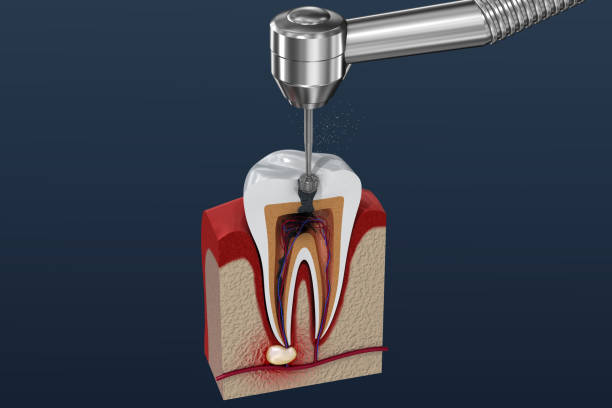
Dental burs are small rotary cutting instruments that fit into a handpiece and allow dentists to remove tooth structure, shape restorations, and finish surfaces with precision. Every bur consists of two parts: a working head that does the cutting and a shank that locks into the handpiece. While the handpiece provides the rotation, it is the bur head that determines what material can be cut, how aggressively it cuts, and what kind of surface finish it leaves behind.
The two primary families of dental burs are diamond burs and tungsten carbide burs. Each has distinct manufacturing methods, cutting characteristics, and clinical applications. Understanding these differences helps practitioners select the right instrument for every procedure and avoid unnecessary steps during tooth preparation.
Diamond Burs
Diamond burs feature a stainless steel or nickel-plated blank with fine diamond particles bonded to the working end. These diamond particles go through decontamination, demagnetization, spheronization, and purification before being attached to the blank. The result is an abrasive surface with excellent sharpness and wear resistance that can cut through enamel, porcelain, and other hard dental materials efficiently.
How Diamond Burs Cut
Unlike bladed instruments that slice material away, diamond burs work by grinding. Thousands of tiny diamond crystals act as individual cutting points, each removing a small amount of material with every rotation. This grinding action produces a slightly rough surface, which is ideal for bonding but may require additional finishing steps when a smooth margin is needed.
During use, some diamond particles will gradually detach from the bur surface. A diamond bur is generally considered spent once roughly half of its abrasive coating has worn away. At that point, cutting efficiency drops noticeably, and the clinician should switch to a fresh bur. Continuing to use a worn diamond bur forces the operator to apply more pressure, which generates excess heat and increases the risk of pulp damage.
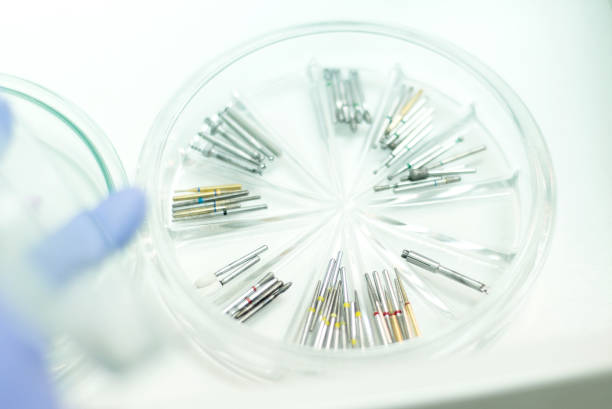
Common Uses for Diamond Burs
- Crown and bridge preparation on enamel and dentin
- Porcelain adjustment and contouring after cementation
- Bulk reduction of tooth structure for full-coverage restorations
- Endodontic access through porcelain-fused-to-metal crowns
- Roughening surfaces before bonding procedures
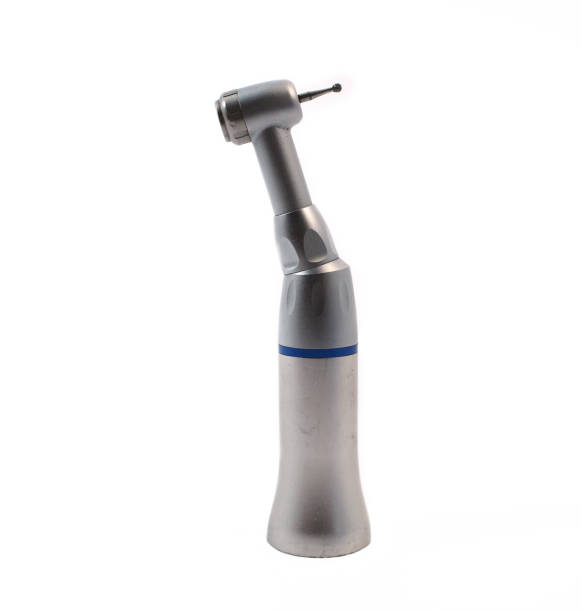
Diamond burs are manufactured in FG (friction grip) shanks for high-speed handpieces and HP shanks for laboratory use. The FG version is by far the most common in clinical practice, while HP diamond burs are used on the bench for adjusting porcelain, zirconia, and other ceramic materials outside the mouth.
Tungsten Carbide Burs
Tungsten carbide burs are manufactured by sintering tungsten carbide powder with cobalt powder under vacuum at high temperature, then shaping and dressing the head with a large diamond grinding wheel. The finished head is welded onto a steel shank, creating a one-piece instrument with precisely machined flutes or blades.
How Carbide Burs Cut
Carbide burs cut with defined blades rather than abrasive particles. Each flute acts like a tiny chisel, peeling away material in controlled chips. This blade-based cutting action leaves a smoother surface than diamond grinding, which is why carbide burs are often preferred for final tooth preparation steps where margin smoothness directly affects the fit of the restoration.
Because carbide burs produce smoother preparations, they support more accurate impressions and better-fitting all-ceramic restorations with tighter marginal adaptation. They also meet the requirements for minimally invasive tooth preparation, where conserving healthy tooth structure is a priority. The smooth walls left by a carbide bur reduce the need for additional finishing, saving clinical time.
Common Uses for Carbide Burs
- Finishing and refining preparation margins after initial diamond reduction
- Cutting retention grooves, barrel holes, and dovetail slots
- Removing old amalgam restorations without damaging surrounding tooth structure
- Trimming and adjusting acrylic temporaries and provisional crowns
- Flat leveling of cavity floors before restoration placement
Carbide burs are available in both FG and RA (right angle) shanks. FG carbide burs fit high-speed handpieces, while RA carbide burs are designed for slow-speed contra-angle handpieces, which are commonly used for caries excavation and finishing work at lower RPM.
Diamond vs Carbide: Side-by-Side Comparison
| Feature | Diamond Burs | Tungsten Carbide Burs |
|---|---|---|
| Cutting mechanism | Abrasive grinding | Blade/flute cutting |
| Surface finish | Rougher (good for bonding) | Smoother (good for margins) |
| Best for | Bulk reduction, enamel cutting | Finishing, detail work |
| Wear pattern | Diamond particles shed over time | Blades dull gradually |
| Material compatibility | Enamel, porcelain, ceramics | Dentin, acrylic, amalgam, composites |
| Typical lifespan | Single-use to 3-5 uses | 5-10+ uses with proper care |
Many procedures benefit from using both types in sequence: a diamond bur for initial reduction followed by a carbide bur for margin refinement and finishing. This two-stage approach is standard practice for crown and bridge preparations and produces the best combination of speed and surface quality.
Understanding Grit Color Codes
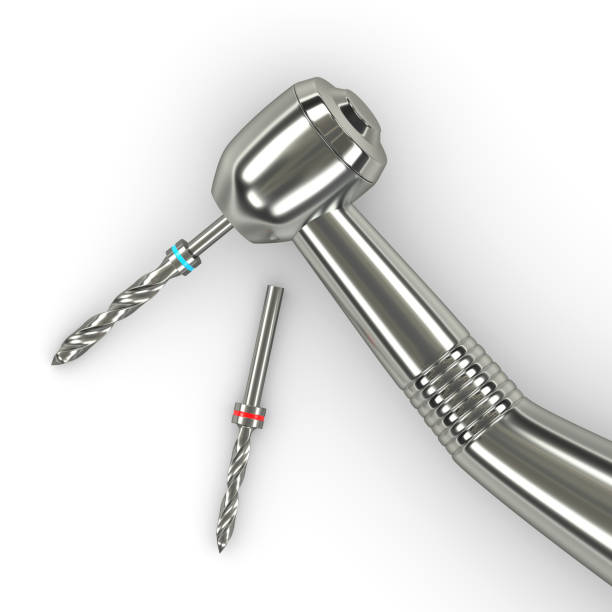
Both diamond and carbide burs use a color-coded band on the shank to indicate grit or blade count. Learning this system lets you identify any bur at a glance without needing to check the packaging. The standard color progression from most aggressive to finest is shown below.
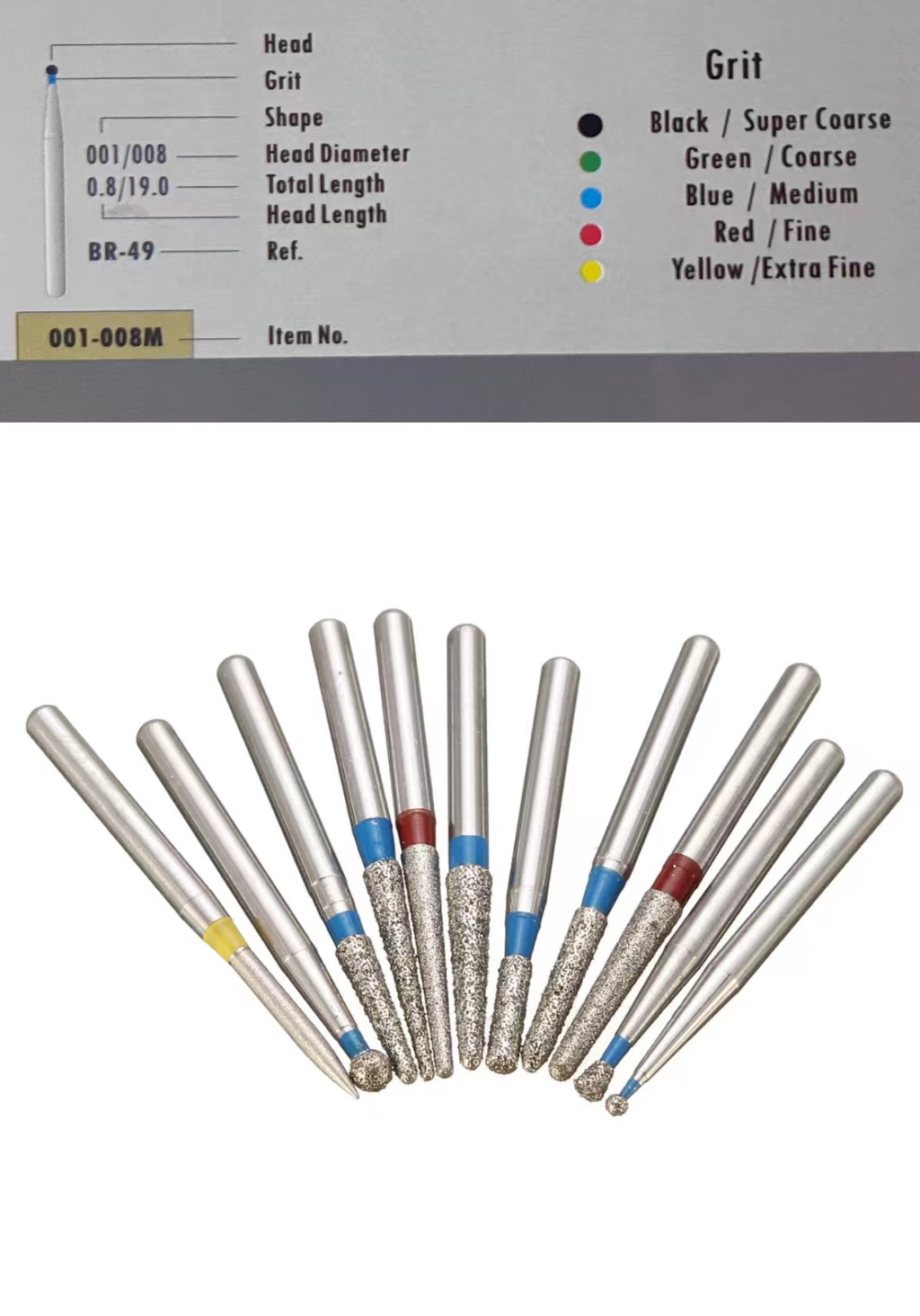
| Color Band | Grit Level | Diamond Particle Size | Carbide Blade Count | ISO Code |
|---|---|---|---|---|
| Black | Extra-coarse | ~150 microns | Up to 8 blades | SC |
| Green | Coarse | ~125 microns | Up to 8 blades | C |
| Blue | Standard/Medium | ~105 microns | Up to 8 blades | No letter / M |
| Red | Fine | ~45 microns | 10-14 blades | F |
| Yellow | Extra-fine | ~25 microns | 16-20 blades | EF / XF |
How Grit Selection Affects Clinical Outcomes
Coarser grits (black and green bands) remove material quickly but leave a rough surface. They are best suited for initial reduction steps where speed matters more than finish quality. Standard grit (blue band) handles the majority of everyday preparation work and offers a good balance between cutting speed and surface quality.
Fine and extra-fine grits (red and yellow bands) cut slowly but produce exceptionally smooth surfaces. Red-banded finishing burs are routinely used for final margin preparation, while yellow-banded burs create surfaces smooth enough that minimal or no polishing is needed afterward. Choosing the correct grit for each stage of preparation directly affects how well the final restoration will fit and how long it will last.
Popular Head Shapes and Their Applications
Dental burs come in dozens of head shapes, each designed for specific access requirements and preparation geometries. For a full classification of shapes and ISO numbering, see the dental bur types guide. Some of the most frequently used shapes include:
- Round (RA 1-8) — Caries removal, access openings, and retention pin holes. Round burs are among the first shapes every dental student learns to use and remain a daily workhorse in general practice.
- Pear (329, 330, 331) — Cavity preparation, especially for Class I and Class II restorations. The 330 carbide bur is one of the most commonly used shapes in restorative dentistry.
- Tapered Fissure (169, 170, 171) — Crown preparations with a defined taper angle for proper draw. The taper angle built into the bur head helps ensure that the preparation walls converge correctly for full-coverage restorations.
- Flat-End Cylinder (556, 557) — Shoulder preparations and flat cavity floors. These burs produce sharp, well-defined internal line angles.
- Flame — Subgingival margin finishing and interproximal contouring. The narrow, pointed profile allows access to tight spaces between teeth.
- Football / Egg — Occlusal surface contouring and lingual concavity shaping. The rounded profile is useful for creating smooth, anatomical contours in composite or amalgam restorations.
Selecting the Right Bur for Each Procedure
Because every patient presents with different anatomy, tooth position, and restoration requirements, no single bur works for every case. However, a few general principles apply:
- Start with the least aggressive bur that will get the job done. Over-reduction wastes healthy tooth structure and cannot be reversed.
- Use as few bur changes as possible. Each handpiece swap adds time and disrupts workflow. Planning the bur sequence in advance reduces unnecessary exchanges.
- Match the bur to the material being cut. Diamond burs are preferred for enamel and porcelain; carbide burs work better on dentin, acrylic, and metal.
- Finish with a finer grit than you think you need. A smoother preparation margin translates directly to a better-fitting restoration and a more comfortable result for the patient.
- Consider the handpiece speed. High-speed handpieces paired with diamond burs are ideal for bulk reduction, while slow-speed handpieces with carbide burs give better tactile feedback during finishing and caries excavation.
Maintenance and Longevity
Proper care extends bur life and maintains cutting performance. After each use, burs should be cleaned to remove debris, inspected for wear or damage, and sterilized according to the manufacturer's protocol. Diamond burs benefit from ultrasonic cleaning to remove material lodged between particles. For detailed cleaning steps, the guide on cleaning diamond burs covers the full process.
Carbide burs should be examined under magnification for chipped or bent blades. A bur with a damaged blade will cut unevenly and leave a rough, unpredictable surface. Replacing worn burs promptly is always less costly than remaking a poorly fitting restoration.
Organizing burs in a labeled bur block or stand also helps extend their service life. Loose burs rattling together in a drawer can chip each other's cutting edges, reducing performance before the bur ever reaches the handpiece. A well-organized storage system lets you find the right bur quickly, reduces accidental damage, and makes inventory tracking straightforward.